
The smarter way to source hotel supplies, restaurant accessories, resort furniture and commercial equipment — without confusing a low price with a good deal.
A restaurant manager finds a beautiful rechargeable table lamp on Amazon.
Price: $24.
It looks perfect for the outdoor dining area. The design is attractive, the reviews seem promising, and delivery is available within days.
Then someone on the purchasing team finds what appears to be the same lamp on Alibaba.
Price: $7.
Suddenly, the Amazon option looks ridiculously expensive.
Why pay $24 when you can buy it for $7?
There’s just one problem.
The Alibaba supplier wants a minimum order of 100 units. Shipping is quoted separately. Import duties haven’t been calculated. The warranty terms are unclear. And nobody has tested how long the battery actually lasts.
That $7 lamp might still be a fantastic purchase.
Or it might become a very expensive lesson.
In hospitality procurement, the price you see on the screen is rarely the whole story.
And that’s exactly why the Amazon-versus-Alibaba question deserves more thought than simply comparing two listings.
First, understand what you’re actually comparing
Amazon and Alibaba serve different purchasing needs.
Amazon is primarily a retail marketplace, although Amazon Business also supports business purchasing, commercial accounts, and quantity discounts on eligible products.
Alibaba.com is a business-to-business marketplace connecting buyers with manufacturers, wholesalers, and trading companies. It is particularly useful when buyers want larger quantities, customization, or direct supplier relationships.
Neither platform automatically offers the lowest total cost.
And neither platform guarantees that every listed product is suitable for commercial hospitality use.
A product that works perfectly in someone’s home may fail quickly when used by hundreds of restaurant or hotel guests.
That distinction matters.
Amazon vs Alibaba: The quick comparison
| Buying factor | Amazon / Amazon Business | Alibaba |
|---|---|---|
| Small quantities | Usually convenient | Depends on supplier and MOQ |
| Bulk purchasing | Available on selected listings | Often a central strength |
| Product customization | Usually limited | Often available |
| Delivery speed | Often faster for local stock | Depends on production and shipping |
| Comparing customer reviews | Often convenient | Supplier verification requires more work |
| Import arrangements | Can be simple for domestic purchases | Often require additional planning |
| Samples | Buy individual units where offered | Request samples from suppliers |
| Returns and disputes | Depend on listing and seller terms | Depend on order terms and protection eligibility |
| Best use | Testing, replacements, smaller orders | Scaling, custom orders, wholesale sourcing |
Amazon Business explicitly offers business pricing and quantity discounts on eligible items. These discounts are not universal and can vary by listing and purchase quantity.
Alibaba offers supplier assessment tools and its Trade Assurance program, but supplier verification and purchase protection do not eliminate the need for independent checks.
The important question is not which marketplace is better.
It’s which purchasing method suits the product, quantity, risk, and operating requirements.
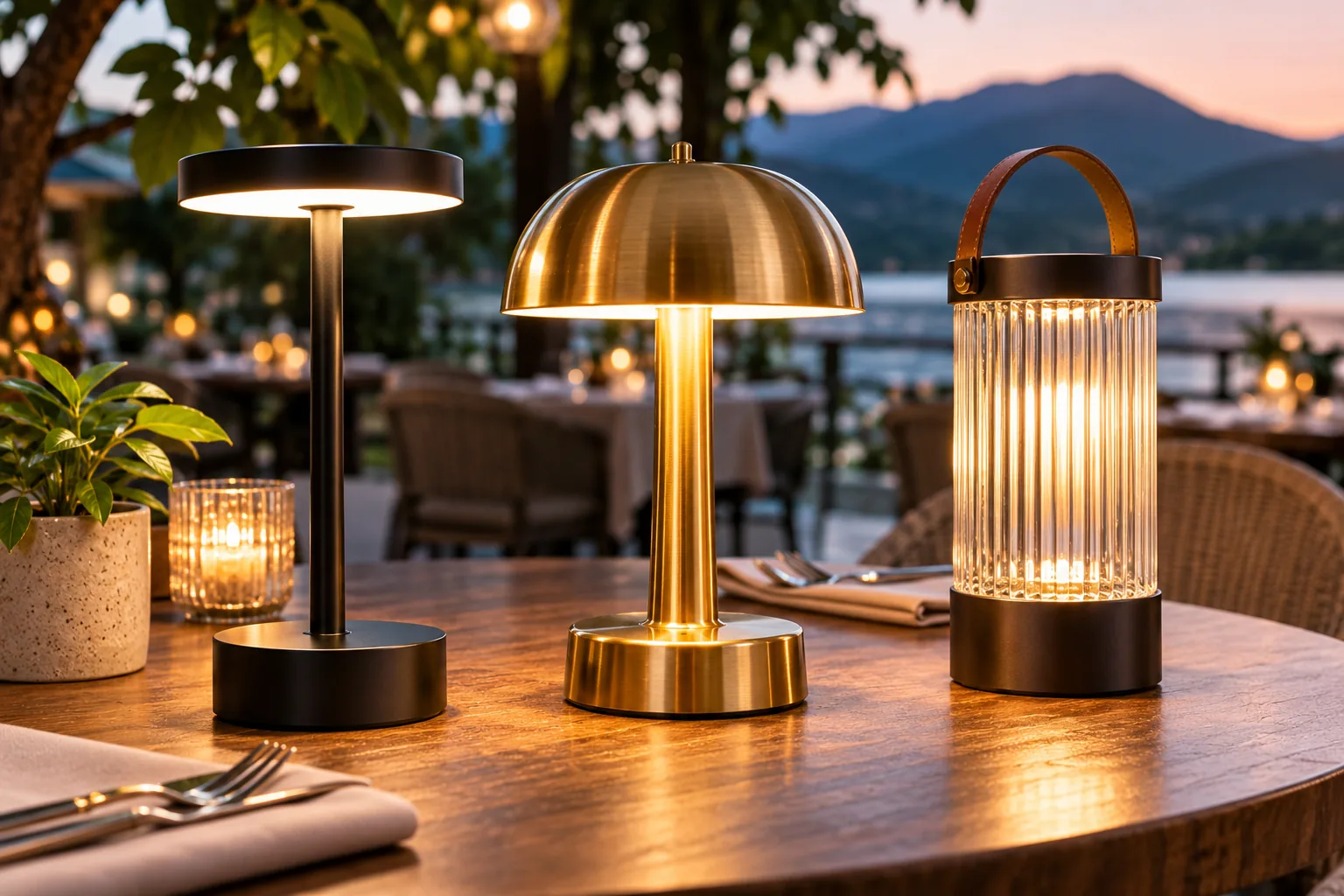
1. When Amazon is the smarter choice
You need five serving accessories, not five hundred.
Imagine introducing a new dessert presentation at your restaurant.
You want to test miniature sauce pitchers, dessert glasses, or small serving boards.
The idea looks promising, but you don’t know whether guests will respond to it.
Would you order 200 pieces directly from a factory?
I wouldn’t.
I’d begin with a few samples.
Amazon can be useful for this stage because you can compare dimensions, materials, customer feedback, and delivery options across multiple products.
You may also find several different styles without negotiating with multiple factories.
Products I’d consider buying in small quantities
- Miniature dessert sauce pitchers
- Rechargeable table lamps for testing
- Menu holders and table accessories
- Small serving trays
- Decorative room accessories
- Reception desk organizers
- Photography and content-creation accessories
- Replacement items needed urgently
The advantage isn’t necessarily the lowest price.
It’s flexibility.
You can buy three different designs, place them in a real operating environment, and discover which one works.
A practical example
Suppose you want cordless table lamps for your restaurant.
You could buy three different models and test them for two weeks.
Ask your team to evaluate:
- Actual battery life during evening service
- Brightness and colour temperature
- Stability on outdoor tables
- Charging convenience
- Resistance to spills and cleaning
- Guest feedback
- Ease of obtaining replacement units
Only after this test would I consider a larger order.
The Qasim Verdict
Amazon is a useful starting point when you’re testing an idea, buying smaller quantities, or replacing noncritical equipment quickly.
But don’t mistake a high customer rating for proof of commercial durability.
A lamp that performs well in a home might not survive daily restaurant use.

2. When Alibaba becomes more interesting
Buying 100 identical items changes the mathematics.
Now imagine you’re opening a boutique resort with 40 guest rooms.
You need matching luggage racks, waste bins, bathroom accessories, hangers, and perhaps customized amenity trays.
Buying everything individually at retail prices may become expensive.
This is where Alibaba can be worth investigating.
Instead of choosing from finished retail products, you may be able to communicate directly with a manufacturer or wholesale supplier.
You can request specifications, compare quotations, and explore customization.
Products worth researching through Alibaba
- Hotel room accessory sets
- Custom-branded amenity packaging
- Commercial outdoor furniture
- Restaurant tableware in larger quantities
- Uniforms and staff accessories
- Decorative lighting in bulk
- Customized serving trays
- Noncritical guest-room furnishings
For branded products, suppliers may offer custom colours, logos, packaging, and dimensions.
But customization usually introduces additional considerations.
You may face minimum order quantities, setup charges, artwork approval, longer lead times, and restrictions on returns.
The MOQ trap
MOQ means minimum order quantity.
Suppose a supplier quotes $6 per unit with an MOQ of 200.
That means you’re committing to at least $1,200 in product cost before freight, taxes, or other charges.
If you need only 30 units, the apparent savings may be irrelevant.
And if the first 30 units reveal a quality problem, you’re left with another 170.
The Qasim Verdict
Alibaba becomes more attractive when you know exactly what you need, have tested the product, and can justify the order quantity.
Don’t increase your order simply to qualify for a cheaper unit price.
Unsold or unused inventory isn’t a saving.
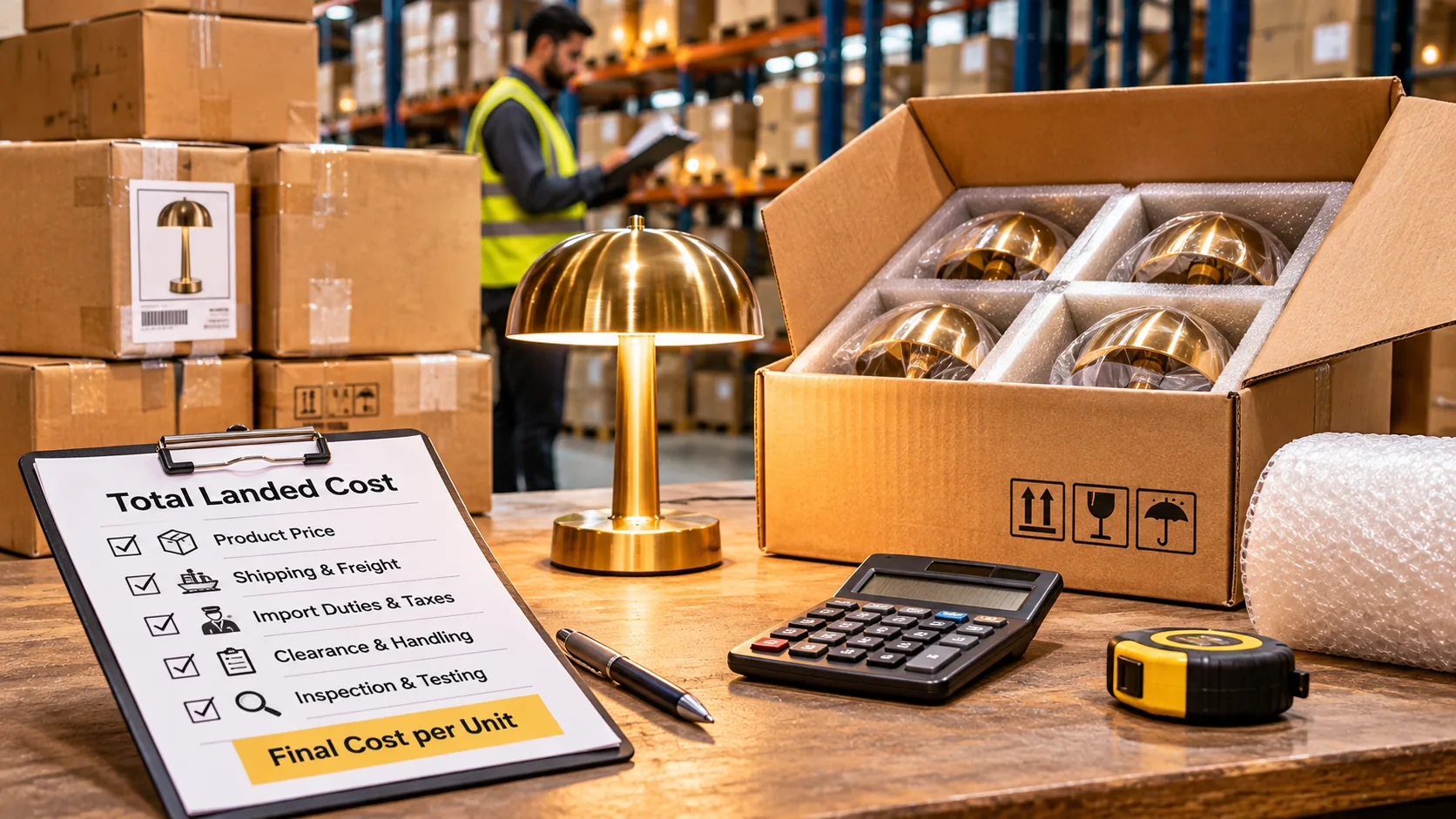
3. The hidden cost: Why a $7 product can cost $15
The number that matters is landed cost, not factory price.
Let’s return to the cordless table lamp.
Assume you’ve identified an Alibaba supplier offering 100 lamps at $7 each.
Here’s an illustrative calculation.
| Cost component | Amount |
|---|---|
| 100 lamps × $7 | $700 |
| Freight and insurance | $250 |
| Import duties and taxes | $180 |
| Clearance and handling | $100 |
| Inspection and miscellaneous costs | $70 |
| Total landed cost | $1,300 |
| Landed cost per lamp | $13 |
These figures are hypothetical. They are not actual supplier quotations or country-specific import charges.
At $13 per unit, the factory purchase still looks attractive compared with a $24 retail lamp.
But what if you only need 20?
You have tied up money in 80 additional lamps.
And what if the lamps arrive with incompatible chargers, poor batteries, or insufficient water resistance?
The lower purchase price may disappear quickly.
What about shipping terms?
When requesting an international quotation, you’ll encounter terms such as EXW, FOB, and DDP.
These are not interchangeable.
Under EXW, the buyer generally assumes substantial responsibility for collecting and moving the goods from the seller’s premises.
Under DDP, the seller assumes more of the delivery and import-clearance obligations under the agreed Incoterms rule.
FOB applies to sea and inland waterway transport and allocates responsibilities around delivery on board the vessel.
The International Chamber of Commerce’s guidance on Incoterms 2020 is a useful reference.
For an international hospitality purchase, always establish who is responsible for freight, customs clearance, duties, taxes, insurance, and delivery to your property.
Don’t assume the supplier’s quoted price includes everything.
The real comparison
Compare:
Amazon: Delivered price for the exact quantity you need.
Alibaba: Total landed cost for the quantity you’re required to purchase, including inspection and other expenses.
Then consider warranty, replacement availability, delivery time, and product lifespan.
That’s a much more useful comparison than $24 versus $7.
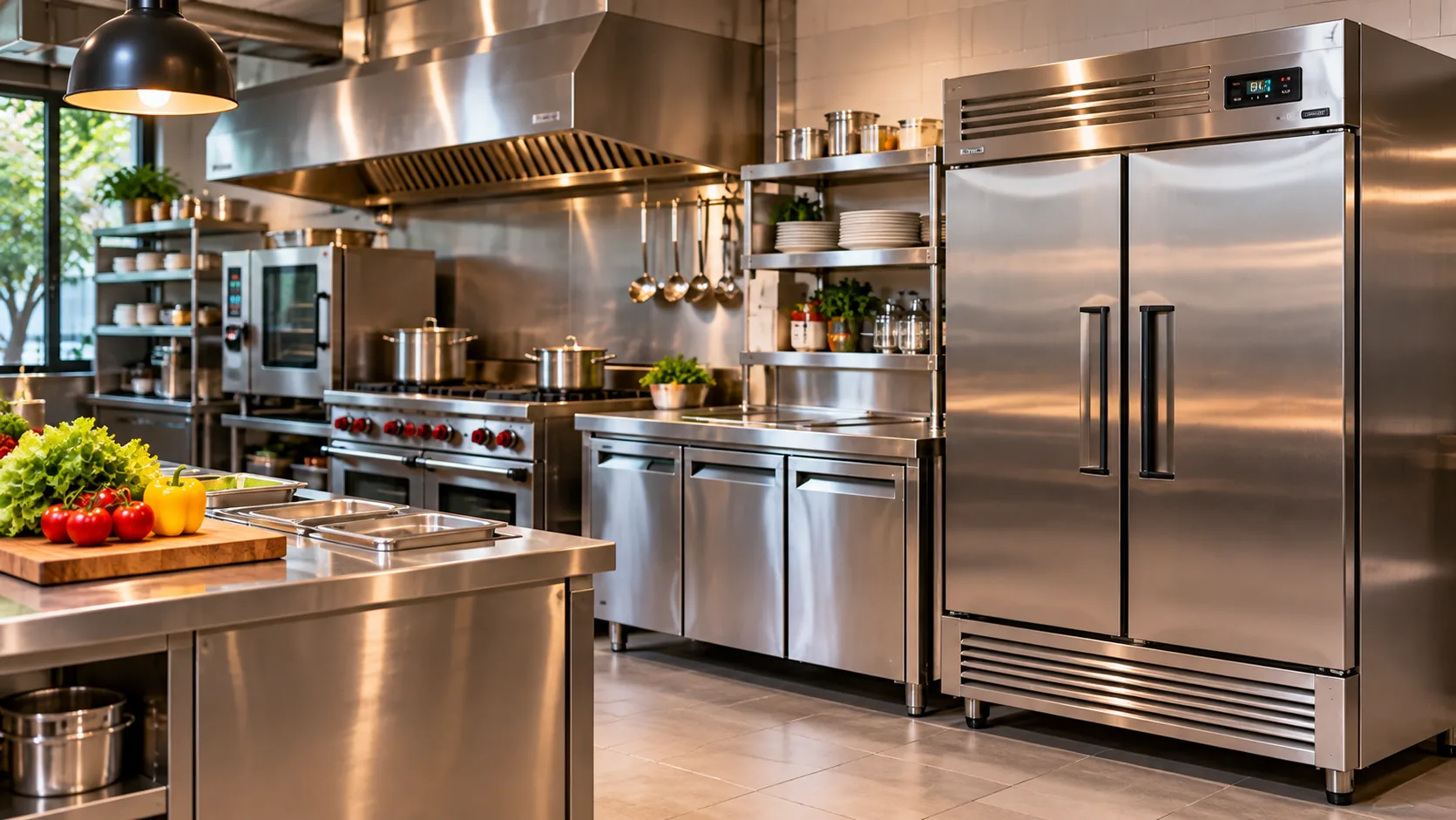
4. The third option most buyers overlook: Hospitality suppliers
Sometimes neither Amazon nor Alibaba is the right place to buy.
Imagine your restaurant’s commercial refrigerator stops working on a Friday evening.
You find an inexpensive replacement online.
It has the right capacity and looks attractive.
But who will install it?
Who will repair it?
Where will you find a replacement compressor or thermostat?
And what happens to your food inventory if the equipment fails again?
For critical commercial equipment, I would strongly consider specialist hospitality distributors, established equipment dealers, or qualified local suppliers.
They may offer installation, maintenance, spare parts, and technical support.
That can be more valuable than a lower purchase price.
Examples of specialist suppliers worth comparing
For buyers in the United States, companies such as WebstaurantStore and KaTom Restaurant Supply provide extensive commercial foodservice catalogues.
In the United Kingdom, Nisbets is another established source for catering and hospitality equipment.
These are sourcing options to compare, not endorsements of every product they sell. Check local availability, delivery coverage, certification, and warranty terms.
For Australia and European markets, investigate established commercial kitchen and hospitality distributors in your country, particularly when installation and after-sales service matter.
Equipment I’d be cautious about importing independently
- Commercial refrigeration
- Ice machines
- Commercial cooking equipment
- Gas appliances
- Large dishwashers
- Commercial electrical installations
- Safety-critical outdoor structures
- Pool and water-treatment equipment
These products can involve regulatory, electrical, sanitation, installation, and maintenance requirements.
For example, NSF’s commercial food equipment standards address factors such as material safety, hygienic design, cleanability, and product performance.
The relevant certification requirements vary by product and jurisdiction.
The Qasim Verdict
For equipment whose failure could interrupt operations, endanger guests, or compromise food safety, after-sales support should carry serious weight in the purchasing decision.
A slightly higher price from a reliable commercial supplier can be worthwhile.
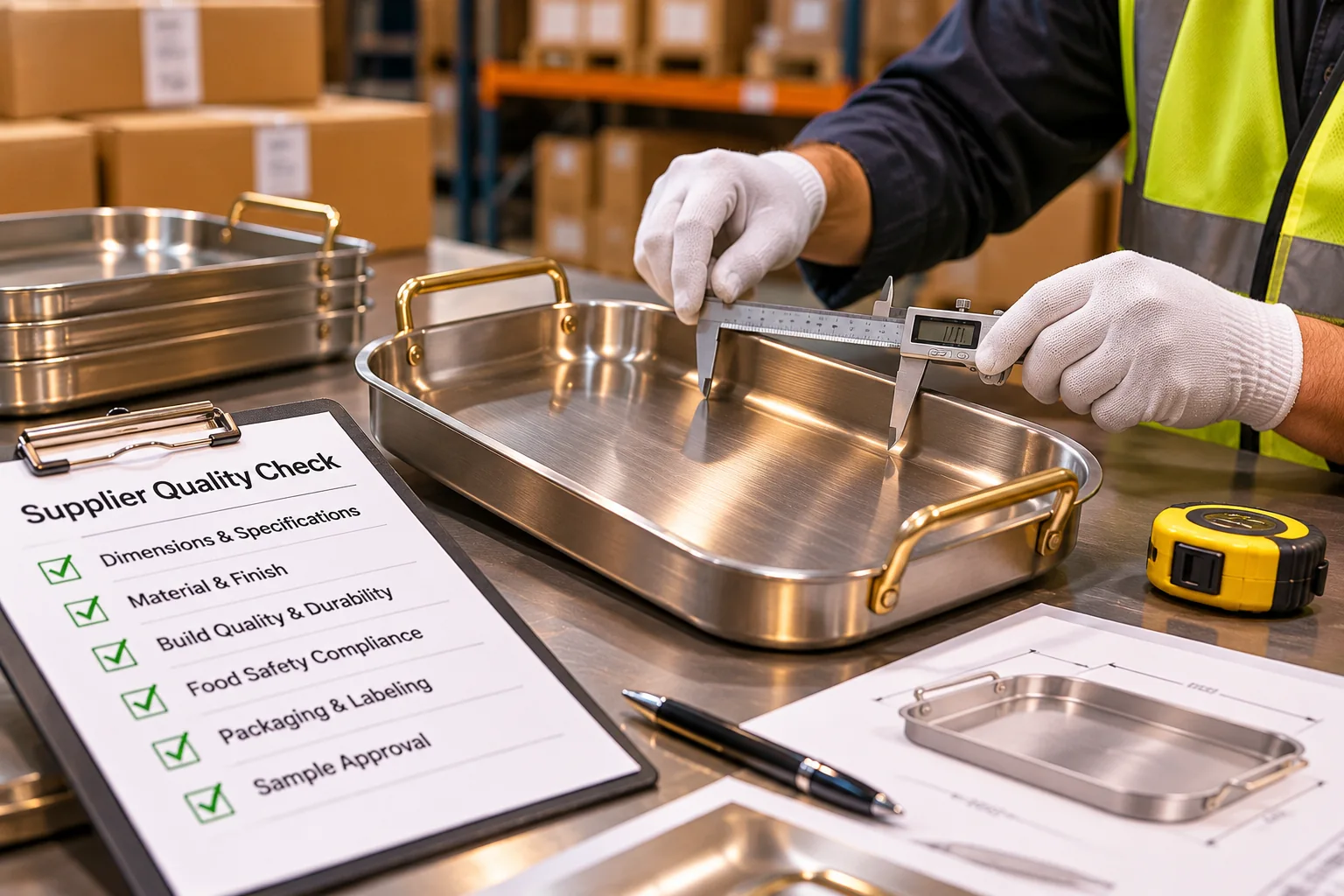
5. How to check an Alibaba supplier before paying
A professional-looking product photograph proves very little.
Alibaba provides tools to help buyers assess suppliers.
Its Buyer Central guidance describes supplier badges and profile information, including Verified Supplier status.
But a badge should be treated as a starting point, not a final quality guarantee.
Alibaba itself states that Verified Supplier assessments are conducted by independent third parties and that it does not guarantee the authenticity or accuracy of all associated information.
My supplier-checking process
First: Compare at least three suppliers.
Send the same specifications and quantities to each one.
This makes quotations easier to compare.
Second: Ask whether the supplier is a manufacturer or trading company.
Both can be legitimate. The important thing is understanding who controls production, quality, and after-sales support.
Third: Request a sample.
Evaluate the actual material, dimensions, finish, packaging, and performance.
A sample is especially important when buying items that guests will handle repeatedly.
Fourth: Ask for relevant test reports and certifications.
Don’t simply accept a certificate image. Verify the document, the issuing body, the product model, and whether the certification applies to the intended use.
Fifth: Put specifications in writing.
Include material grades, dimensions, colour, tolerances, packaging, quantity, delivery requirements, and agreed quality standards.
Sixth: Consider independent inspection.
For significant orders, a qualified third-party inspection before shipment can help identify problems before the goods leave the factory.
What about Trade Assurance?
Alibaba’s Trade Assurance program provides eligible order protection and dispute-resolution support.
Its published refund policy covers certain problems such as missing, defective, damaged, or incorrect goods, subject to applicable terms and deadlines.
That’s helpful.
But it isn’t a substitute for a well-written purchase agreement.
Make sure the order documents specify exactly what the supplier has promised.
The Qasim Verdict
The best supplier isn’t necessarily the one with the lowest quote or the most impressive catalogue.
It’s the one who can consistently deliver the agreed product, quantity, quality, and documentation.
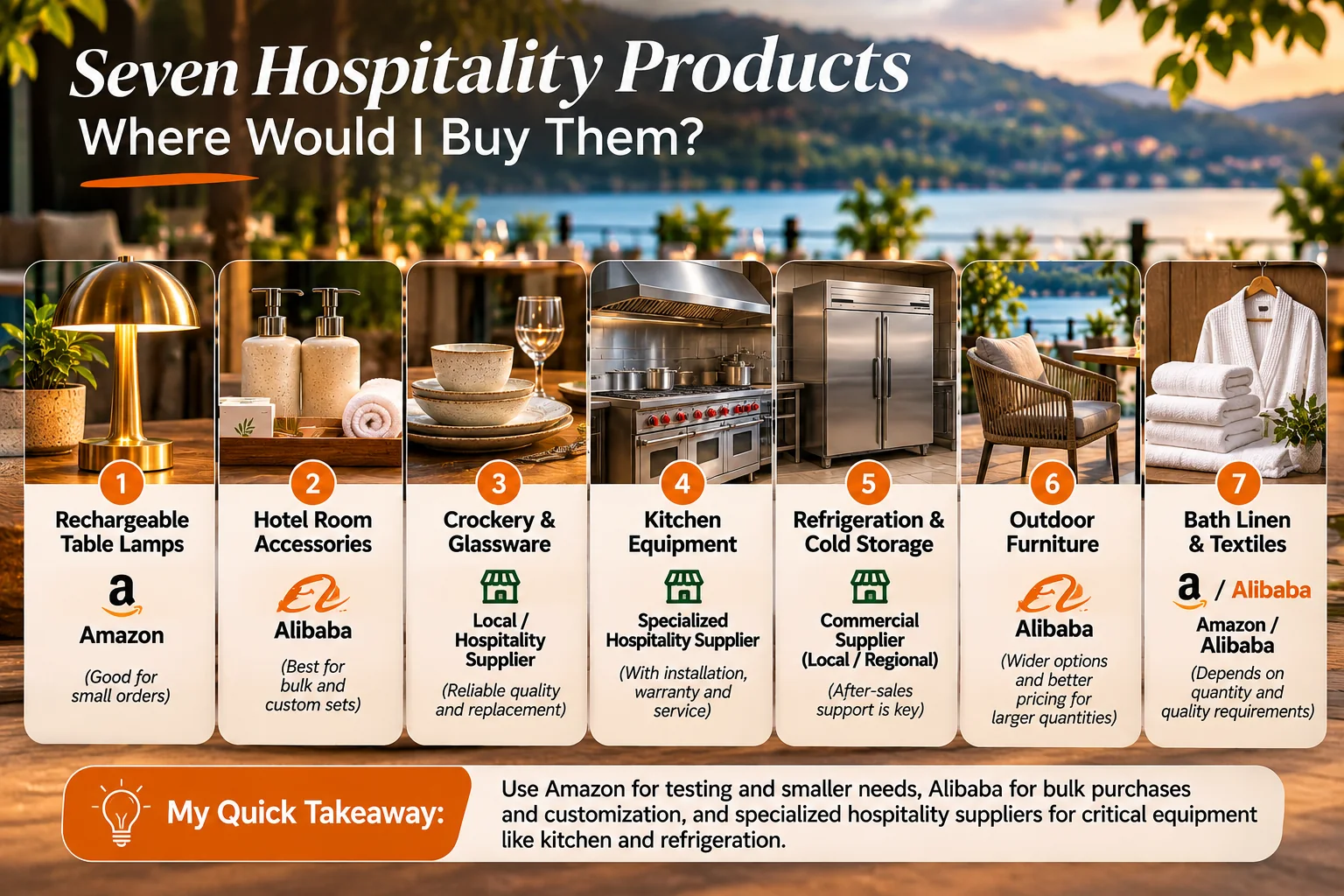
6. Seven hospitality products: Where would I buy them?
Let’s make the comparison practical.
A. Mini dessert sauce pitchers
My starting point: Amazon or a local restaurant-supply store.
Buy a few units, test pouring performance, cleaning, and durability.
Move to wholesale sourcing only when the design is proven and demand justifies the quantity.
B. Rechargeable restaurant table lamps
My starting point: Amazon for samples, then compare commercial suppliers and Alibaba.
Test battery life, charging systems, stability, and suitability for the operating environment.
For outdoor use, verify appropriate ingress protection and other safety requirements.
C. Hotel room amenity trays
My starting point: Alibaba or a specialist hotel-supply distributor.
If you need dozens of matching trays with custom dimensions or branding, direct wholesale sourcing may make sense.
Request a sample and confirm material quality.
D. Commercial refrigerators
My starting point: A specialist commercial equipment distributor.
Prioritize appropriate certification, installation, warranty, service access, and spare parts.
Don’t choose based solely on an online product photograph.
E. Outdoor resort furniture
My starting point: Local commercial furniture suppliers, then Alibaba for larger projects.
Inspect frame materials, corrosion resistance, cushion construction, UV performance, and replacement-part availability.
If possible, test furniture in actual resort conditions before purchasing large quantities.
F. Custom-branded restaurant uniforms
My starting point: A local uniform manufacturer or Alibaba supplier.
For smaller teams, local production can make fittings, adjustments, and replacements easier.
For larger standardized orders, compare factory quotations.
G. Guest-room accessories and decorative items
My starting point: Amazon for prototypes; wholesale suppliers for rollout.
Test guest usability, cleaning, breakage, and consistency before equipping every room.
Quick sourcing matrix
| Product | Best first place to investigate | Why |
|---|---|---|
| Dessert accessories | Amazon / restaurant supplier | Small-scale testing |
| Cordless table lamps | Amazon, then wholesale | Performance validation |
| Custom amenity trays | Alibaba / hotel supplier | Volume and customization |
| Commercial refrigerators | Specialist distributor | Service and compliance |
| Outdoor furniture | Commercial local supplier / Alibaba | Durability and scale |
| Branded uniforms | Local manufacturer / Alibaba | Fit and customization |
| Guest-room decorative items | Amazon, then wholesale | Trial before rollout |
These are recommended sourcing approaches, not universal rules. The best supplier depends on your location, required quantity, and technical specifications.
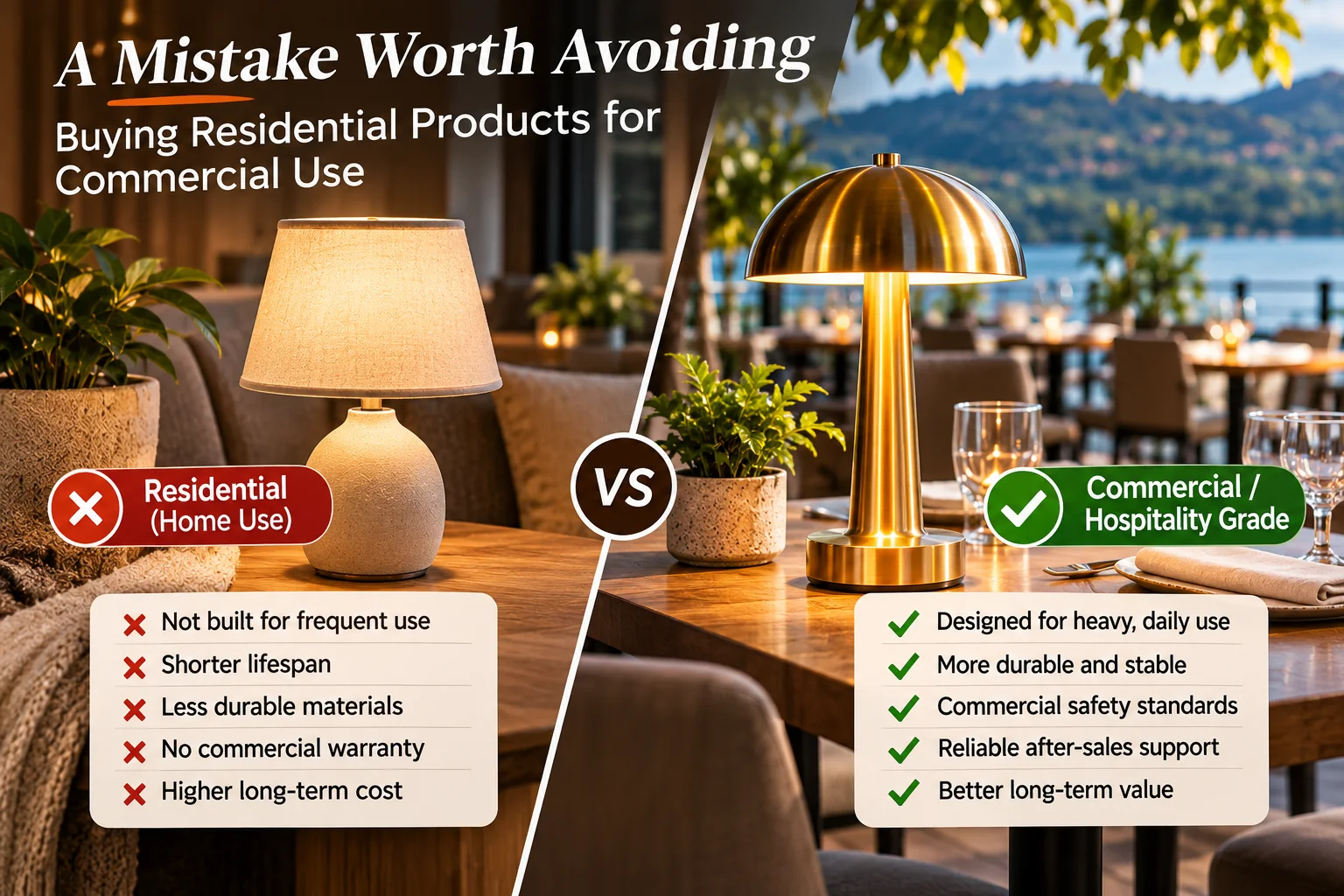
7. A mistake worth avoiding: Buying residential products for commercial use
A product can be beautiful, affordable, and completely unsuitable for a hotel.
Take a dining chair.
A chair designed for occasional use in a home may look identical to one designed for a busy restaurant.
But the operating conditions are very different.
In a restaurant, chairs may be moved, stacked, cleaned, and used repeatedly throughout the day.
The same principle applies to serving accessories, electrical equipment, outdoor furniture, and guest-room fittings.
Before buying, ask:
- Is the product designed for commercial use?
- Can it withstand frequent cleaning?
- Are replacement parts available?
- Does it meet applicable safety and food-contact requirements?
- What happens if it fails during service?
For food-contact products, the US FDA explains that cookware, food preparation surfaces, packaging, and other materials can fall within food-contact substance requirements.
For commercial food equipment, NSF certification may be relevant depending on the equipment and local regulations.
European and UK requirements may differ, so buyers should verify the rules applicable to their market.
A product listing saying “food grade” is not sufficient evidence by itself.
The Qasim Verdict
Buy for the environment in which the product will actually operate.
Hospitality equipment has to survive real hospitality operations, not just look good in photographs.
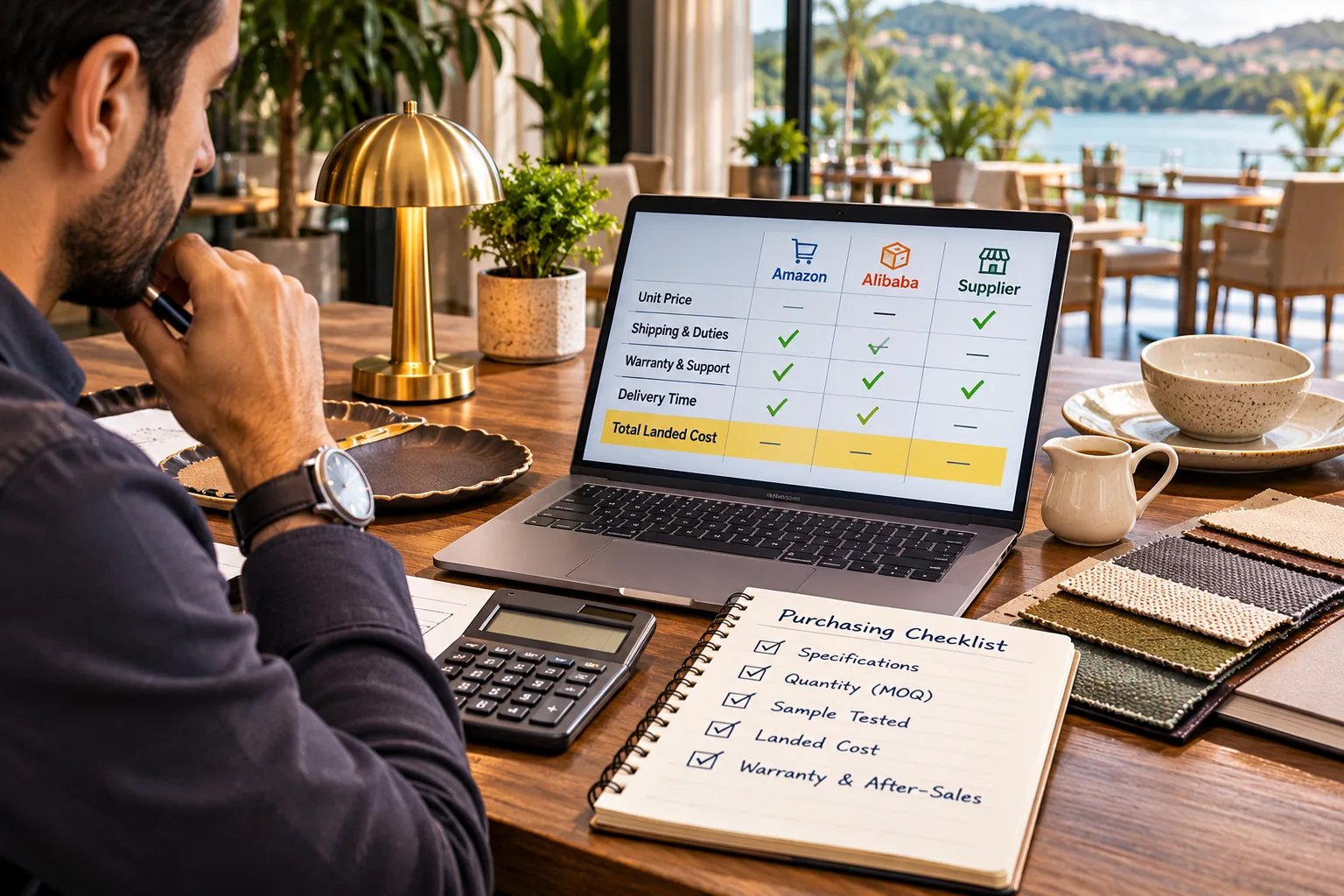
8. The purchasing formula I would use
Before approving a major order, calculate the total cost of ownership.
Start with:
Purchase price + shipping + duties and taxes + installation + expected maintenance + replacement costs + downtime risk.
Not every cost can be predicted perfectly.
But even a rough estimate is better than comparing two advertised prices.
Example: 100 rechargeable table lamps
Assume three options:
| Cost factor | Amazon | Alibaba | Local commercial supplier |
|---|---|---|---|
| Unit price | $24 | $7 | $19 |
| Quantity | 100 | 100 | 100 |
| Product subtotal | $2,400 | $700 | $1,900 |
| Additional delivery/import/inspection | $0 | $600 | $100 |
| Total acquisition cost | $2,400 | $1,300 | $2,000 |
| Cost per unit | $24 | $13 | $20 |
These are illustrative figures only, not current supplier quotations.
Alibaba appears cheapest in this example.
But suppose the local supplier includes an enforceable warranty and readily available replacements.
That could make the $20 option more attractive over time.
Or suppose the Alibaba lamps pass inspection, meet your specifications, and can be reordered reliably.
Then the $13 landed cost may offer genuine value.
The point is to evaluate the complete purchasing decision.
Don’t ignore working capital
Buying 100 items when you only need 20 ties up cash.
That cash might be better used for marketing, maintenance, staffing, or other operational priorities.
A lower unit price doesn’t automatically justify a larger order.
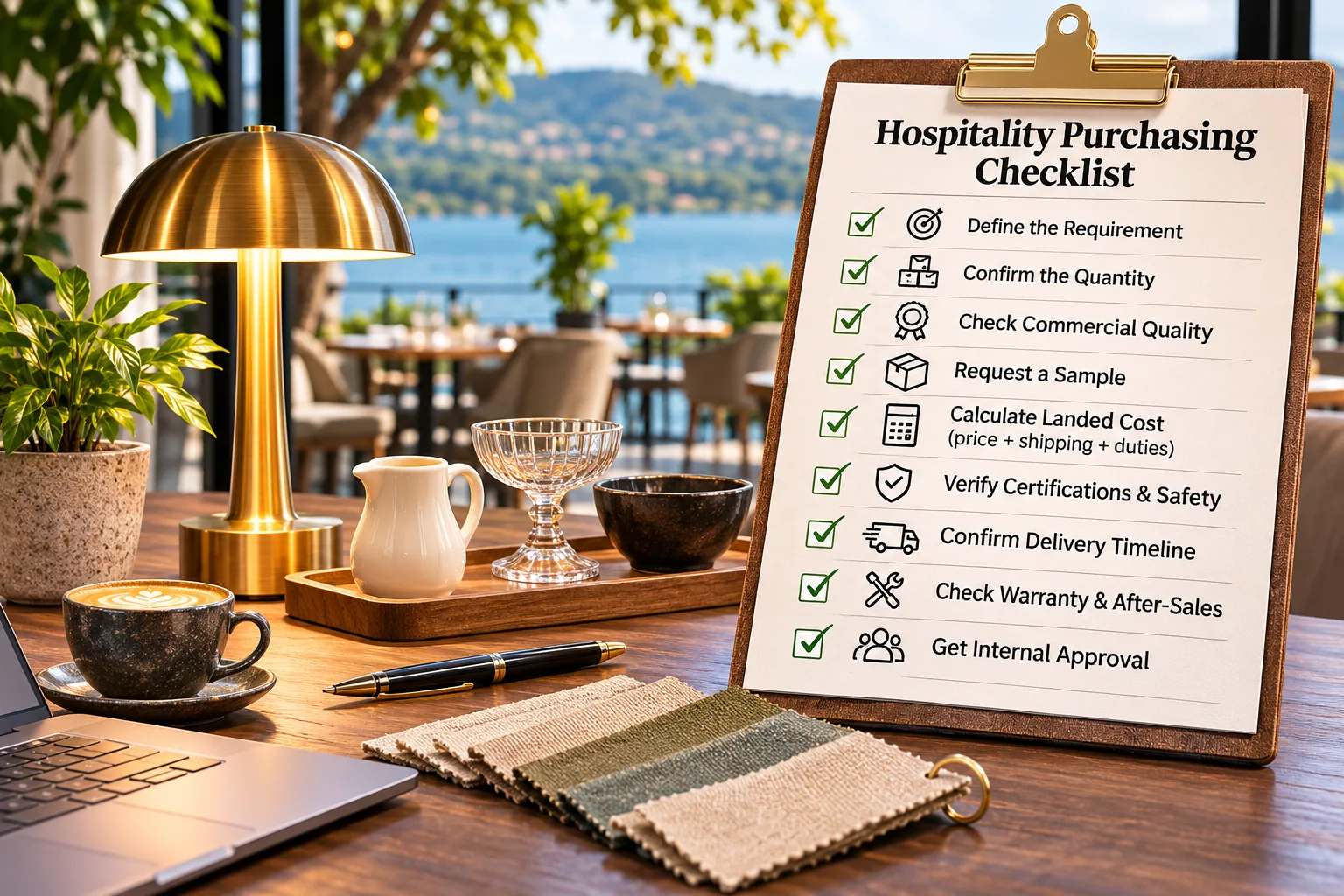
9. The purchasing checklist I would give every hospitality manager
Before placing an order, make sure the team can answer these questions.
| Question | What to verify |
|---|---|
| What exactly are we buying? | Written specifications and intended use |
| How many do we actually need? | Current demand plus justified spare stock |
| Is a sample available? | Physical testing before bulk purchase |
| Is it suitable for commercial use? | Durability, certification and safety |
| What is the landed cost? | Freight, taxes, duties and handling |
| Who handles installation? | Qualified provider where required |
| What happens if it fails? | Warranty, spare parts and repairs |
| When will it arrive? | Confirmed production and delivery schedule |
| What are the payment terms? | Documented terms and protection |
| Who approves the purchase? | Internal accountability and budget control |
A good purchasing process doesn’t need to be complicated.
It needs to prevent expensive surprises.
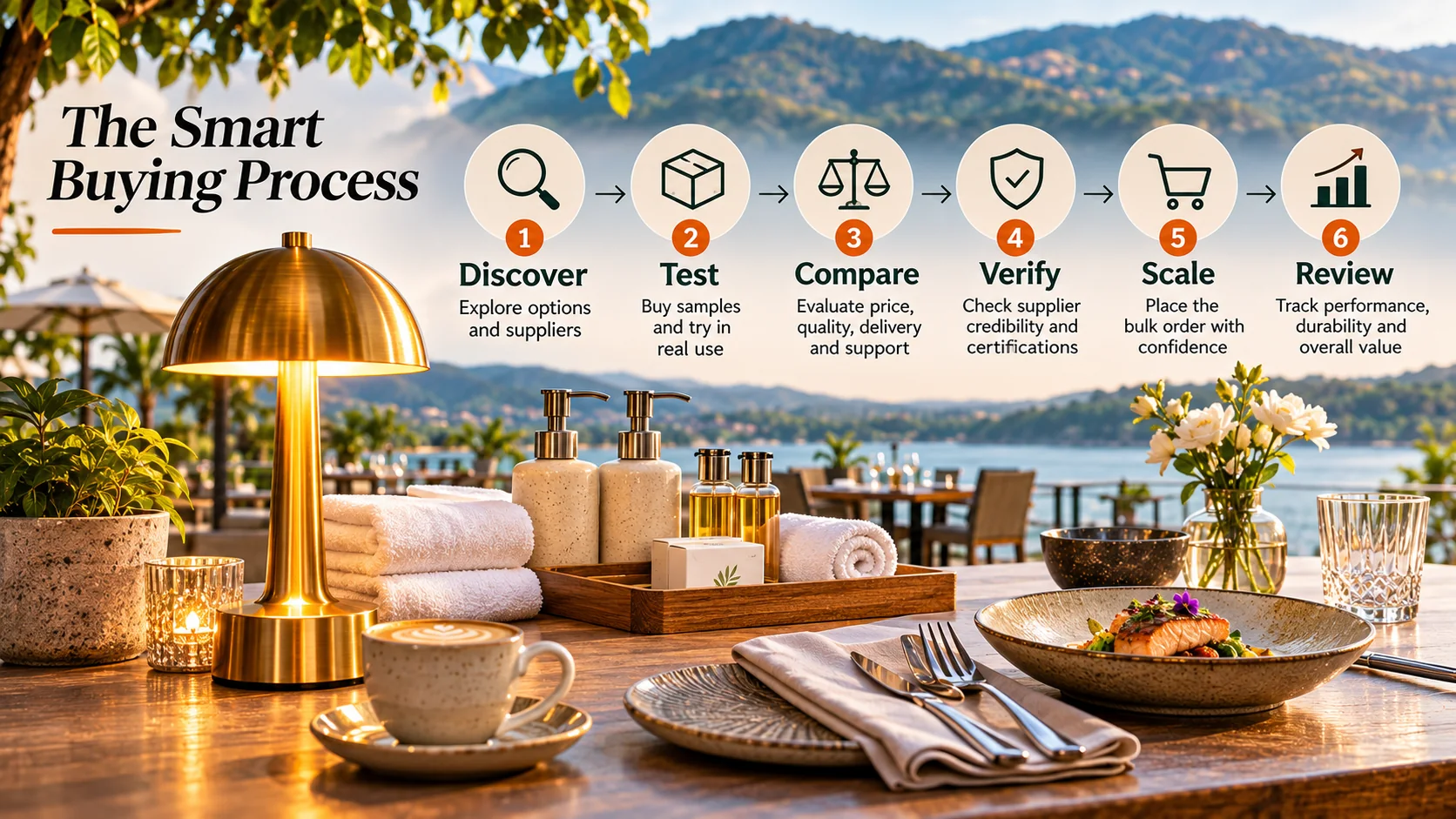
10. My recommended buying strategy: Test, verify, then scale
For most hospitality operators, I wouldn’t choose only Amazon or only Alibaba.
I’d use a combination of sources.
Stage 1: Discover
Explore Amazon, Alibaba, hospitality supplier catalogues, and manufacturer websites to understand available products.
Stage 2: Test
Purchase small quantities or request samples.
Let the actual operating team evaluate them.
Stage 3: Compare
Obtain quotations for the required quantity from several qualified suppliers.
Compare total landed cost, compliance, warranties, and service support.
Stage 4: Verify
Check supplier documentation, product specifications, and quality before committing to a large order.
Stage 5: Scale
Place the larger order only after the product has demonstrated its suitability.
Stage 6: Review
Track failures, breakage, replacement costs, staff feedback, and guest satisfaction.
A product that costs less initially but needs replacing every few months may not be the better investment.
The Qasim Verdict: Don’t be loyal to a marketplace. Be loyal to the right purchasing decision.
So, Amazon or Alibaba?
For small purchases and product experiments, Amazon can be extremely convenient.
For larger quantities, custom designs, and standardized products, Alibaba can open up valuable sourcing opportunities.
For critical commercial equipment, specialist hospitality suppliers may offer the better combination of reliability, technical support, and long-term value.
And for many products, a qualified local manufacturer or distributor deserves a place in the comparison.
The smartest hospitality operators don’t buy everything from one marketplace.
They understand what they’re buying, why they need it, and what it will cost over its useful life.
Before approving the next order, ask one question:
Are we buying the lowest-priced product, or are we making the best purchasing decision for our business?
Those are not always the same thing.
Sources & Further Reading
- Amazon Business — Business Pricing and Quantity Discounts — How business pricing and bulk discounts work.
- Amazon Business — Buying Guide — Business purchasing features and account options.
- Alibaba Buyer Central — How Sourcing Works — Supplier evaluation and purchasing processes.
- Alibaba — Verified Suppliers — Supplier verification framework and its limitations.
- Alibaba — Trade Assurance — Purchase protection and dispute support.
- International Chamber of Commerce — EXW and DDP Explained — International shipping responsibilities.
- NSF — Commercial Food Equipment Certification — Foodservice equipment sanitation and certification.
- US FDA — Food Contact Materials — Food-contact material requirements and safety considerations.
Editorial note: Qasim Diary provides independent hospitality procurement research and operational recommendations. Product examples and financial calculations are illustrative and do not represent verified live quotations, product testing, or guaranteed savings. Supplier terms, certifications, availability, and import costs should be checked before purchasing.