
From answering midnight booking questions to adjusting room prices and managing housekeeping, these five tools deserve a closer look before you expand your payroll.
It’s 11:40 PM.
A guest wants to know whether your hotel allows early check-in.
Another is asking about airport transfers.
Someone on WhatsApp wants the price of a room for next weekend.
Meanwhile, tomorrow’s housekeeping schedule is unfinished, three maintenance requests haven’t been assigned, and your room rates haven’t been reviewed for an upcoming local event.
You’re thinking about hiring another receptionist.
Or perhaps another reservations executive.
That might be the right decision.
But before you advertise the position, there’s a question worth asking:
Do you actually need another employee, or do you need to remove some of the repetitive work your existing employees are doing?
This is where artificial intelligence becomes interesting for small hotels.
Not because AI can replace the warmth of a good receptionist, the judgment of an experienced manager, or the attention of a skilled housekeeper.
It can’t.
But it can help with certain tasks that consume hours without necessarily requiring a human to perform every step.
I’ve selected five tools that address different operational problems: guest communication, room pricing, telephone enquiries, housekeeping coordination, and administrative work.
These aren’t products I’m claiming to have personally tested. They’re a research-based shortlist worth evaluating through demos and controlled trials.
And there’s one important rule before we begin:
Don’t buy five AI subscriptions. Find your biggest operational problem and test one solution first.
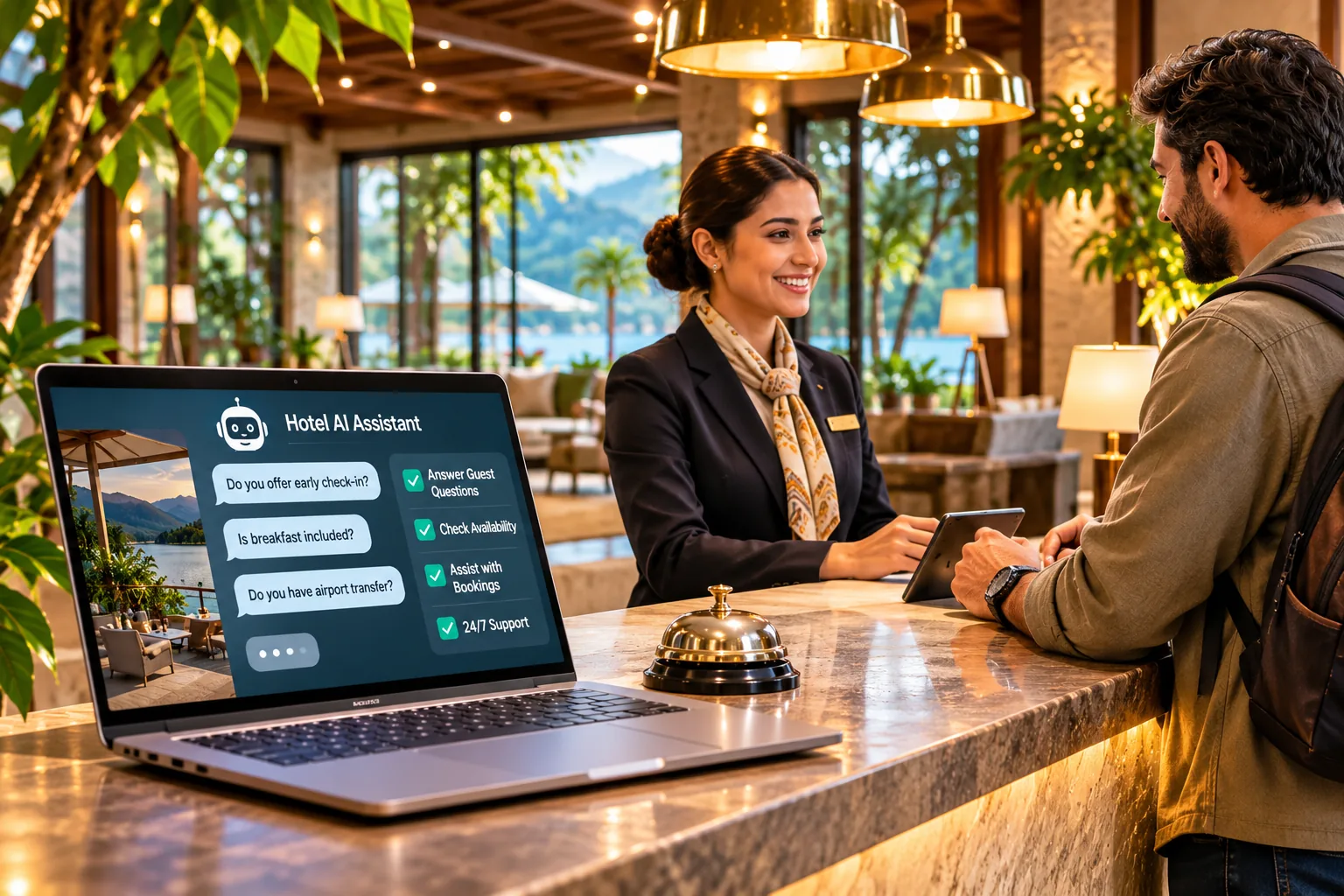
1. HiJiffy — When Your Reception Team Keeps Answering the Same Questions
Best for: Guest enquiries, website chat, multilingual communication, and routine booking questions.
Imagine a 25-room boutique hotel.
Your reception team receives questions throughout the day:
“Is breakfast included?”
“Can we bring children?”
“Do you have parking?”
“How far are you from the airport?”
“Can we check in before 2 PM?”
The answers are usually available in your hotel policies.
But someone still has to read every message and type a reply.
And when several guests contact the hotel simultaneously, response times can suffer.
What HiJiffy does
HiJiffy is a hospitality-focused guest communication platform.
Its AI assistant can answer common questions using hotel-approved information and, with suitable integrations, help guests navigate availability and bookings.
Depending on the selected plan and integrations, the platform supports communication through channels including website chat, WhatsApp, social messaging, email, and online travel agencies.
The company also offers a centralized inbox where employees can take over conversations that require human attention.
That’s the feature I find most important.
A useful hotel chatbot shouldn’t trap guests in automated conversations. It should know when to involve a person.
How I would test it
I’d begin with the 20 questions guests ask most frequently.
Then I’d provide accurate answers covering room types, check-in times, cancellation rules, restaurant hours, parking, and other essential information.
Next, I’d deliberately ask difficult questions.
For example:
“We’re arriving at 6 AM with two children. Can you guarantee an early check-in?”
The correct response shouldn’t promise something the hotel cannot guarantee.
It should explain the policy and direct the request to the reservations team when necessary.
What does it cost?
HiJiffy’s published pricing page lists entry-level plans starting at approximately $109 per month, with more advanced plans starting higher. Pricing varies with room count, billing frequency, features, and setup requirements.
Check the current quotation for your property before budgeting.
What to measure
- Percentage of enquiries resolved accurately
- Average response time
- Number of conversations transferred to employees
- Staff minutes saved
- Booking enquiries successfully converted
- Guest complaints about automated responses
The Qasim Verdict
I’d investigate HiJiffy first if a hotel’s reception or reservations team spends a significant amount of time repeating standard information.
But I wouldn’t let it automatically approve refunds, guarantee unavailable rooms, or make exceptions to hotel policies without appropriate controls.
The objective is faster communication with reliable human backup.
Research: HiJiffy Features | Plans and Pricing

2. PriceLabs — When You’re Guessing What to Charge for Rooms
Best for: Dynamic room pricing, demand monitoring, and revenue management.
Here’s a situation many independent hotel owners will recognize.
You set your weekday room rate at $90.
A major event is announced nearby.
Demand increases, competing properties raise their prices, and your hotel sells out early.
At first, that feels like success.
But later you discover comparable rooms were selling for considerably more.
You filled the hotel.
Did you price it correctly?
Now imagine the opposite.
It’s a quiet Tuesday in the low season. Your rooms are priced too high for current demand, and several remain empty.
These decisions are difficult when an owner is also supervising operations, managing staff, and dealing with guests.
What PriceLabs does
PriceLabs offers a revenue management platform for independent hotels and smaller accommodation businesses.
Its system uses property performance, competitor information, local events, and market demand to recommend or automate room rates.
It can connect with supported property management systems and help managers monitor occupancy, average daily rate, and revenue per available room.
That last metric is called RevPAR.
It’s one of the most useful measurements for understanding how effectively a hotel generates room revenue from its available inventory.
A simple example
Suppose your hotel has 20 rooms.
On a particular night, you sell 15 rooms at an average rate of $100.
Your room revenue is:
15 × $100 = $1,500.
RevPAR is:
$1,500 ÷ 20 available rooms = $75.
Now imagine a pricing strategy results in 14 rooms sold at an average rate of $115.
Room revenue becomes $1,610.
RevPAR becomes $80.50.
You sold one fewer room but generated more room revenue.
That doesn’t automatically mean the second strategy produced more profit. Distribution commissions, variable costs, and other factors still matter.
But it demonstrates why occupancy alone doesn’t tell the whole story.
How I would test it
I’d connect a supported PMS and initially review pricing recommendations rather than allowing unrestricted changes.
I’d set minimum and maximum room rates, review upcoming events, and compare suggested prices with the hotel’s actual booking pace.
I would also check whether the software understands unusual circumstances.
A wedding booking, local road closure, or special group contract can affect demand in ways a pricing system may not fully interpret.
What does it cost?
PriceLabs publishes pricing that varies by geography and number of units. Its hotel pricing information lists a 30-day trial and location-based unit pricing, with discounts applying across additional units.
For a multiroom hotel, calculate the full property subscription rather than assuming a single advertised unit price covers the entire building.
The Qasim Verdict
If a hotel regularly changes room rates manually, PriceLabs is worth investigating before hiring someone whose main responsibility would be monitoring prices.
But revenue management is not just software.
A manager still needs to understand the market, monitor results, and control exceptions.
Research: PriceLabs for Independent Hotels | Pricing
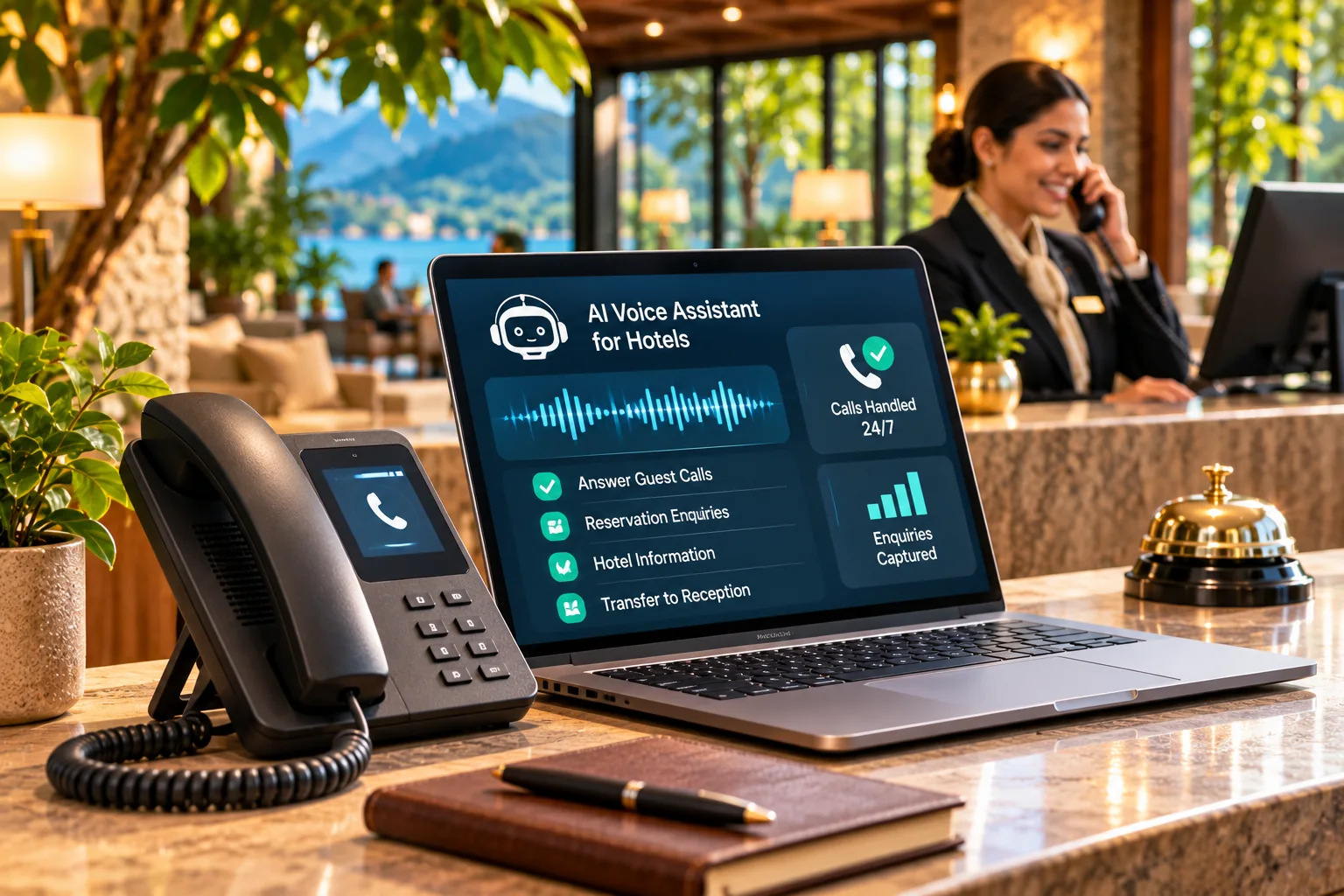
3. Canary AI Voice — When the Phone Rings and Nobody Can Answer
Best for: High call volumes, after-hours enquiries, and routine telephone reservations questions.
A guest calls your hotel at 9:15 PM.
The receptionist is checking in a family.
The phone rings four times and stops.
The guest tries another hotel.
You never know whether that call was about a $20 restaurant booking or a $900 weekend stay.
That’s the frustrating part about missed calls.
You can’t easily measure the revenue opportunities that never reached your team.
What Canary AI Voice does
Canary Technologies offers an AI-powered voice platform designed for hotels.
Its published capabilities include answering routine guest questions, supporting reservation enquiries, handling certain booking-related workflows, and transferring calls when human assistance is needed.
The company has also announced large-scale deployments of its voice technology with hotel partners.
But that doesn’t mean every independent property should immediately adopt it.
Voice AI is especially sensitive to accuracy.
Guests may be calling about late arrivals, lost belongings, accessibility needs, payment problems, or emergencies.
These conversations aren’t all suitable for automation.
How I would test it
I’d begin with after-hours and overflow calls rather than immediately routing every call to AI.
Then I’d test situations such as:
“Can I book a room for tomorrow?”
“I need to change my reservation.”
“I’ve left my passport in the room.”
“There’s an emergency in my room.”
The system must distinguish ordinary enquiries from situations requiring immediate human attention.
It should also clearly identify itself as an automated assistant and follow applicable call-recording and privacy requirements.
What does it cost?
Canary’s AI Voice pricing is generally quotation-based. Ask for the complete cost, including setup, call allowances, overage charges, integrations, and any required platform subscription.
The Qasim Verdict
I’d investigate voice AI if a hotel consistently misses calls or receives substantial repetitive telephone traffic.
I wouldn’t prioritize it for a property receiving only a handful of calls daily.
And I’d never treat it as a substitute for an appropriate emergency response procedure.
Research: Canary AI Voice
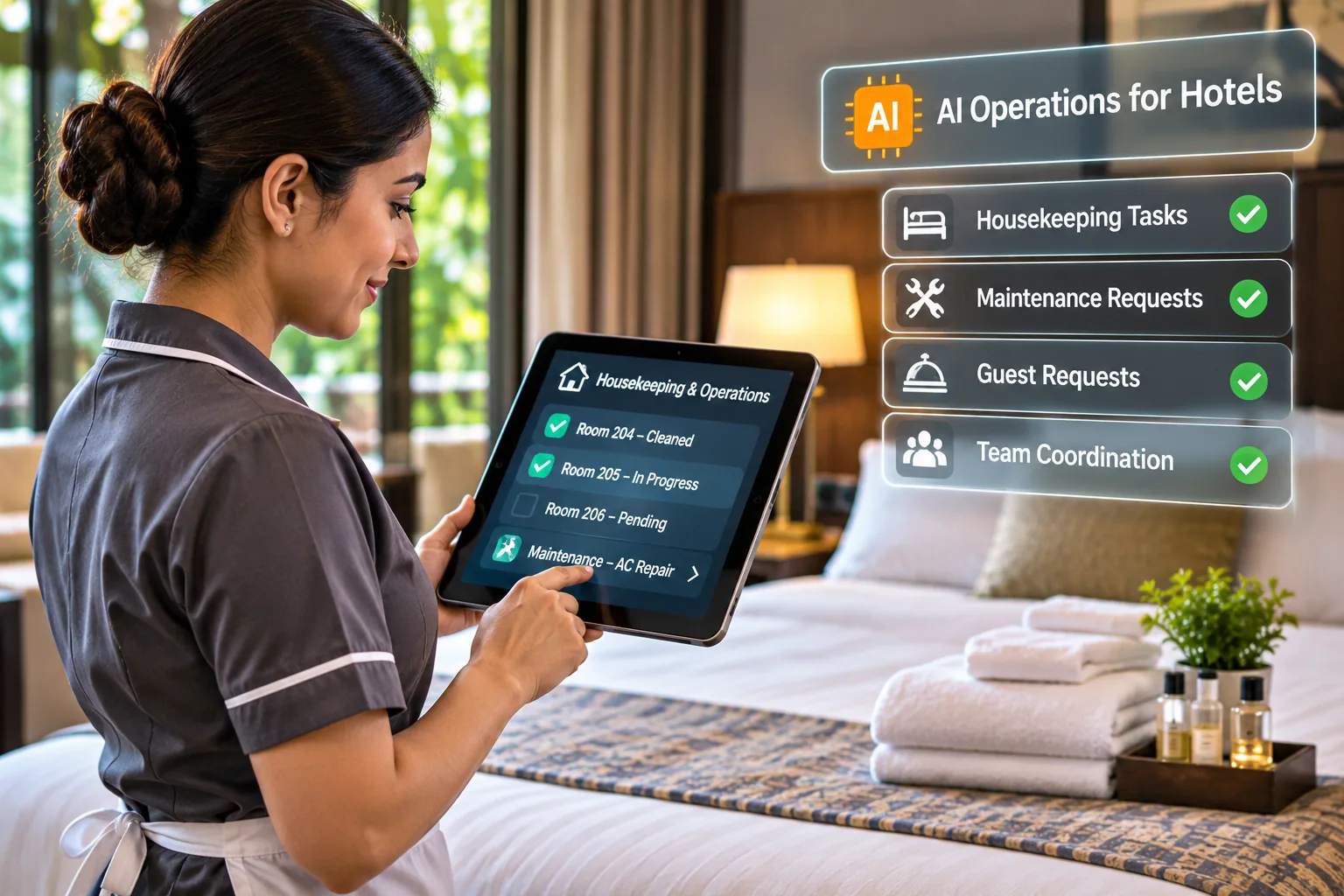
4. Flexkeeping’s Flexie AI — When Housekeeping Communication Is Becoming Chaotic
Best for: Housekeeping coordination, maintenance requests, and multilingual operational teams.
A guest checks out of Room 204.
Housekeeping discovers that the bathroom tap is leaking.
The housekeeper tells a supervisor.
The supervisor calls maintenance.
Maintenance is busy elsewhere.
Reception doesn’t know the room has a problem and assigns it to an arriving guest.
This isn’t necessarily a staffing shortage.
It’s a communication failure.
And hiring another employee won’t automatically solve it.
What Flexie AI does
Flexkeeping provides hotel operations software, including an AI assistant called Flexie.
According to the company’s published materials, Flexie allows hotel employees to communicate tasks through voice, including housekeeping issues, maintenance requests, and guest needs.
Its multilingual capabilities can help teams where employees speak different languages.
The idea is straightforward.
Instead of writing a message, making several calls, or completing a paper form, an employee can communicate the issue through a supported workflow.
The system then helps create or manage the relevant operational task.
How I would test it
I’d start with one housekeeping team and one maintenance team.
For two weeks, I’d track a few common situations:
- Room ready for inspection
- Missing towels
- Faulty air-conditioning
- Bathroom maintenance
- Guest request for an extra pillow
- Room temporarily unavailable
I’d want to see whether tasks are assigned to the correct person, updated reliably, and closed only when the work is complete.
The important limitation
AI can help create and route a maintenance task.
It cannot repair a leaking tap.
It can communicate that a room is ready for inspection.
It cannot guarantee that the room has actually been cleaned to the hotel’s standards.
Physical work still needs people.
Flexkeeping’s own published analysis of its first 1,000 Flexie use cases describes reduced administrative effort, but those are vendor-reported findings rather than independently verified results for every property.
What does it cost?
Request a quotation based on your room count, modules, users, integrations, and onboarding requirements.
The Qasim Verdict
This is one of the more interesting tools for hotels where housekeeping and maintenance communication creates repeated delays.
But before buying software, check whether the existing PMS already offers adequate housekeeping and task-management features.
Sometimes a better process solves the problem without another subscription.
Research: Flexkeeping — Flexie AI Findings
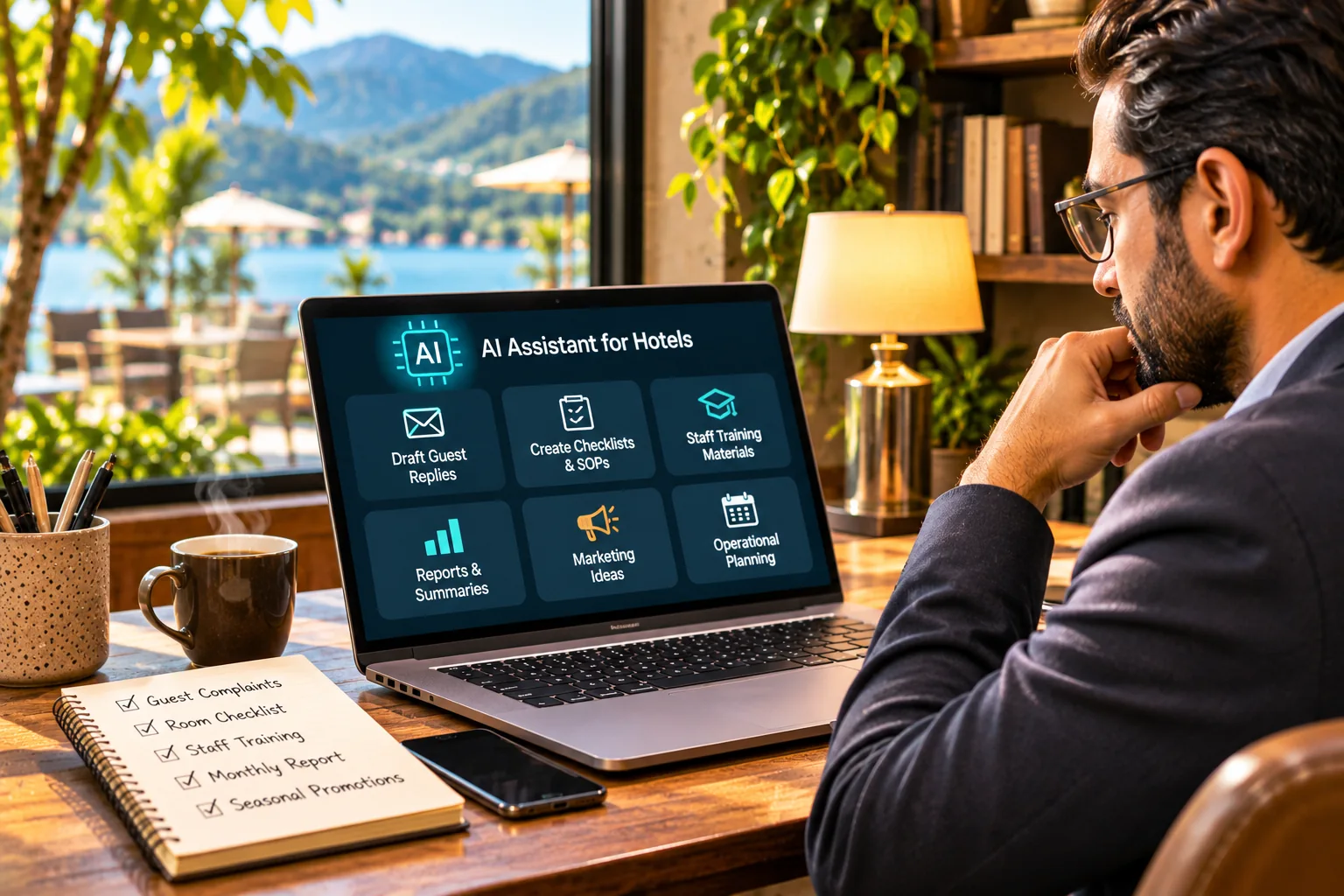
5. ChatGPT Business — When Your Manager Is Buried in Reports, Emails, and Procedures
Best for: Administrative drafting, staff training materials, reporting assistance, and operational documentation.
Not every hotel needs a specialized AI platform for every problem.
Sometimes the work piling up is administrative.
Your manager needs to draft a response to a guest complaint.
The restaurant supervisor needs a new opening checklist.
The HR team needs an interview guide.
The owner wants to understand why operating expenses increased last month.
These tasks don’t always require a new employee.
They may require a better way to organize information and produce first drafts.
What ChatGPT can help with
With suitable oversight and approved information, a hotel team can use ChatGPT to assist with:
Guest communication
Drafting polite replies to complaints, enquiries, and special requests.
Standard operating procedures
Creating checklists for room inspections, opening and closing procedures, and service standards.
Staff training
Preparing role-play scenarios, quizzes, and training guides.
Management reporting
Summarizing non-sensitive or appropriately protected operational data and helping explain financial variances.
Marketing
Brainstorming seasonal packages, restaurant promotions, and content calendars.
A practical example
Imagine the housekeeping manager wants a room inspection checklist.
Instead of starting with a blank document, they could provide the hotel’s approved standards and ask ChatGPT to organize them into a practical checklist.
The manager would then review it, correct omissions, and test it with the team.
The result isn’t a replacement for professional judgment.
It’s a faster starting point.
A prompt worth trying
“Act as a hotel operations consultant. Create a one-page room inspection checklist for a 25-room boutique hotel. Divide it into bathroom, bedroom, safety, amenities, and final presentation. Include a pass/fail column and supervisor sign-off. Keep it practical for a five-minute inspection. Do not invent legal requirements.”
The important part comes afterward.
Someone who understands the hotel must review the checklist before using it.
What does it cost?
ChatGPT offers different plans, including Business options intended for teams. Check the current pricing and features before subscribing.
Business workspaces have data protections that differ from some consumer configurations. Still, hotel owners should review their own privacy obligations and avoid uploading unnecessary guest personal information, passport details, payment card information, or confidential employee records.
The Qasim Verdict
For a small hotel without a large administrative department, a general-purpose AI assistant can be a useful starting point.
I’d begin with checklists, training documents, internal summaries, and draft correspondence.
I wouldn’t give an AI assistant unrestricted authority to approve refunds, make financial commitments, or issue legally sensitive decisions.
Research: ChatGPT Business | Business Data and Security
Which AI tool should a small hotel investigate first?
The answer depends on where the business is losing time or money.
| Hotel’s biggest problem | Tool to investigate | First result to measure |
|---|---|---|
| Repetitive guest questions | HiJiffy | Accurate enquiries handled without staff |
| Inconsistent room pricing | PriceLabs | RevPAR and pricing workload |
| Missed telephone calls | Canary AI Voice | Qualified calls captured |
| Housekeeping coordination | Flexkeeping / Flexie AI | Task completion and room turnaround |
| Administrative workload | ChatGPT Business | Time spent drafting and preparing reports |
These aren’t independently tested rankings. They’re practical starting points based on each product’s stated capabilities.
One hotel may benefit from several tools.
Another may need none of them.
If your property receives only 10 guest enquiries daily, a dedicated chatbot may be difficult to justify.
If you have 12 rooms and a stable seasonal pricing strategy, sophisticated revenue management software may be unnecessary.
If your housekeeping team is already well coordinated, adding another system may simply create more work.
Buy software to solve a measured problem, not because AI is fashionable.
The numbers: Can AI actually be cheaper than hiring?
Let’s imagine a 25-room hotel considering an additional part-time reservations or administrative employee.
Assume the estimated monthly employment cost is $1,500.
Now suppose the hotel is considering an AI tool costing $250 per month, plus a one-time setup cost of $500.
The comparison might initially look simple.
But the correct question isn’t whether $250 is less than $1,500.
It’s how much useful work the software can reliably handle.
A hypothetical monthly calculation
| Item | Amount |
|---|---|
| Staff time saved | 35 hours |
| Fully loaded labour cost | $18/hour |
| Value of time released | $630 |
| Software subscription | $250 |
| Additional oversight and support | $80 |
| Estimated monthly net capacity value | $300 |
This example assumes the released staff time can be productively redeployed. It doesn’t mean the hotel receives $300 in cash savings or can eliminate a position.
And it excludes the one-time setup cost.
The value is operational capacity: employees have more time to serve guests, follow up on sales, and complete other work.
That’s useful.
But it’s different from reducing payroll.
A more important question
What happens during the busiest two hours of the day?
If AI saves 35 hours spread across a month but your reception desk still needs two people simultaneously at check-in, you may still need another employee.
AI doesn’t automatically solve peak-hour staffing requirements.
It can, however, reduce repetitive work so existing employees can concentrate on the moments that matter.
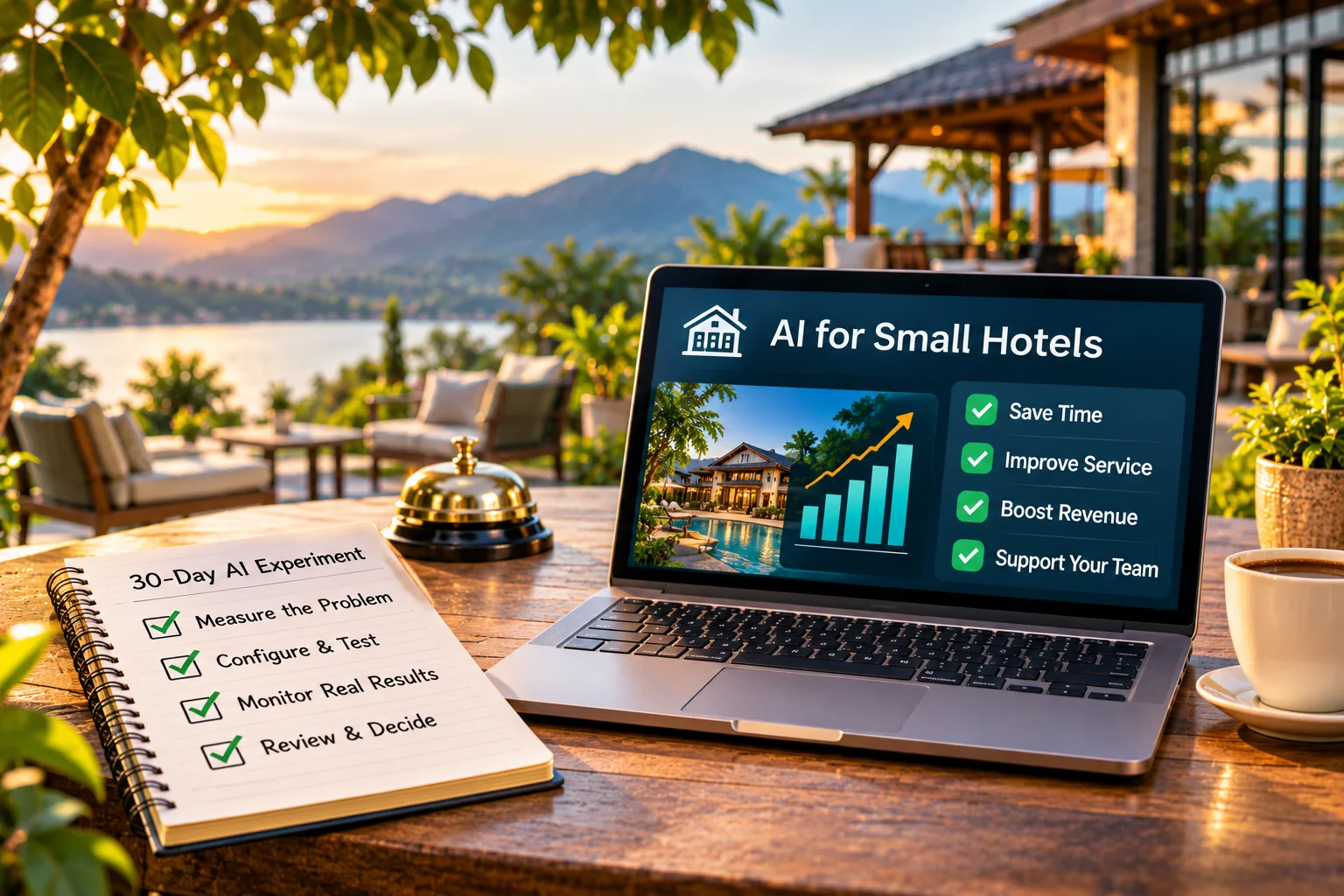
The 30-day AI experiment I would run
Before committing to an annual subscription, I’d run a controlled pilot.
Week 1: Measure the problem
Choose one department.
Record the number of enquiries, calls, tasks, or pricing updates.
Estimate the time spent and identify recurring mistakes.
Week 2: Configure one tool
Start with accurate property information.
Connect only the systems needed for the trial.
Define which actions require employee approval.
Train the staff who will use it.
Week 3: Test real situations
Monitor the system daily.
Check accuracy, response quality, guest feedback, staff workload, and technical issues.
Make sure difficult cases are escalated correctly.
Week 4: Review the results
Compare performance with the original baseline.
Ask whether the tool reduced workload, improved service, generated additional revenue, or created new problems.
Don’t rely solely on the vendor’s dashboard.
Ask your employees what actually changed.
My decision rule
I’d continue only if the tool demonstrates a measurable benefit, works reliably with existing systems, and doesn’t compromise the guest experience.
Otherwise, I’d cancel the trial or revisit the process.
Five mistakes I’d avoid before introducing AI
1. Automating a broken process.
If your team doesn’t have accurate room information or clear service policies, AI may simply deliver incorrect answers faster.
2. Paying for overlapping software.
Check your existing PMS, booking engine, and communication platforms before adding new subscriptions.
3. Ignoring guest privacy.
Hotel systems may process personal and reservation information. Verify data protection arrangements, permissions, retention policies, and applicable legal requirements.
4. Allowing AI to make promises it cannot keep.
Room availability, refunds, accessibility arrangements, emergency requests, and unusual booking conditions may require human verification.
5. Measuring success only by reduced labour.
A tool that improves response times, reduces missed bookings, or gives staff more time with guests can be valuable even if payroll stays unchanged.
The Qasim Verdict: Hire people for hospitality. Use technology for repetition.
Would I recommend investigating AI before hiring more staff?
Yes — when the proposed new role is primarily intended to handle repetitive, measurable work.
I’d investigate guest communication tools before expanding a reservations team solely to answer common questions.
I’d explore revenue management software before assigning someone hours of manual rate monitoring.
And I’d examine operational systems before adding supervisors to chase housekeeping updates.
But I wouldn’t use AI as an excuse to understaff a hotel.
Guests still need people who can solve problems, show empathy, maintain rooms, prepare food, respond to emergencies, and make thoughtful decisions.
Technology should make those employees more effective.
Not leave them responsible for an impossible workload.
The hotels that use AI well won’t necessarily be the ones with the fewest employees.
They’ll be the ones whose employees spend less time on repetition and more time creating memorable stays.
Before hiring another person, find out what your existing team is spending its time doing.
The answer might surprise you.
Sources & Further Reading
- HiJiffy — Guest Communication Platform — Guest messaging, AI assistance, and integrations.
- HiJiffy — Plans and Pricing — Published subscription tiers and features.
- PriceLabs — Revenue Management for Independent Hotels — Automated pricing and performance tools.
- PriceLabs — Pricing — Trial information and subscription structure.
- Canary Technologies — AI Voice for Hospitality — AI telephone assistance and reservations workflows.
- Flexkeeping — Flexie AI Findings — Vendor-reported findings from early hotel operations use cases.
- ChatGPT — Business Plans — Team-oriented AI features and pricing.
- ChatGPT — Work Cloud Security — Business workspace security and data-handling information.
- The Hotel Yearbook 2026 — Technology Edition — Industry discussion of AI integration and operational oversight.
Editorial disclosure: This article is an independently written research-based overview. The tools have not been personally tested for this article. Vendor capabilities, pricing, and performance claims should be verified through current demonstrations, written quotations, and real-world trials. Any future affiliate or sponsored relationships should be clearly disclosed.