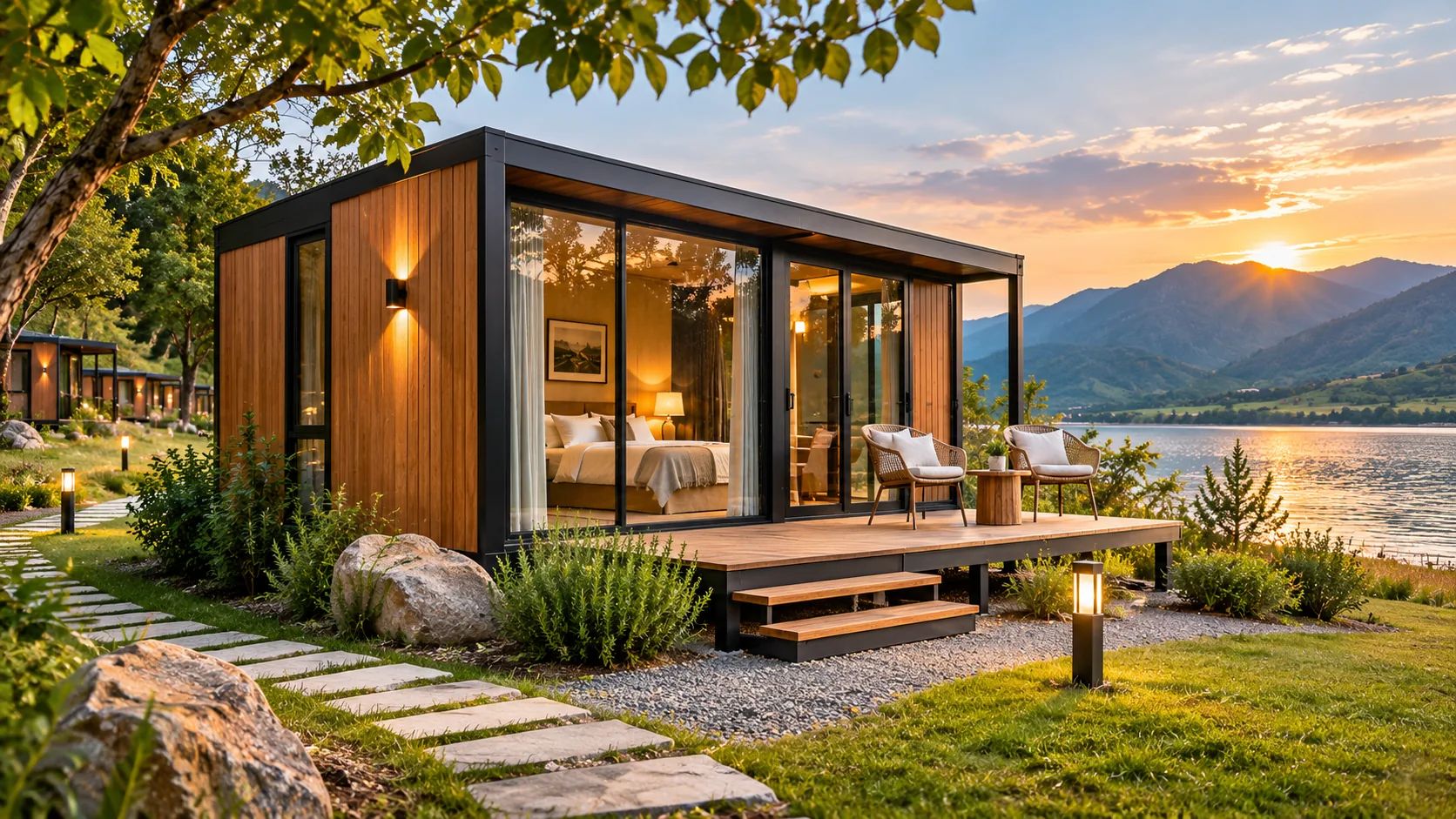
The cabin might cost $25,000. But how much will it cost to welcome your first paying guest — and how many nights will you need to sell before the investment makes sense?
Imagine you own a beautiful piece of land overlooking a lake.
There are trees, mountains, fresh air, and a view that people would happily photograph.
But there’s no accommodation.
Building a conventional hotel feels expensive. Construction could take months, possibly longer. You’d need architects, contractors, permits, utilities, and a substantial budget before receiving your first guest.
Then you discover a prefabricated cabin online.
Floor-to-ceiling windows. A private deck. A comfortable bed. A compact bathroom.
The advertised price is $25,000.
Suddenly, developing a small hospitality business seems surprisingly achievable.
Could you install three cabins, list them on Airbnb, and start earning?
Possibly.
But here’s where I’d stop looking at the beautiful photographs and start asking questions.
Does that $25,000 include delivery?
What about foundations, electricity, water, sewage, heating, furniture, landscaping, permits, and insurance?
Can the cabin withstand your local climate?
Will people actually pay to stay there on a Tuesday in February?
And perhaps the most important question:
Are you investing in a cabin, or are you investing in a hospitality business?
Those are two very different things.
1. Why Prefabricated Cabins Are Worth Investigating
The attraction is understandable.
A conventional accommodation project can involve a long construction schedule, multiple contractors, weather delays, and extensive site work.
Prefabrication moves part of that process into a factory.
Depending on the system, manufacturers may produce wall panels, structural sections, or nearly complete accommodation units before transporting them to the final site.
The Modular Building Institute explains that factory production and on-site preparation can sometimes happen simultaneously, reducing the overall construction schedule.
Its industry guidance describes potential schedule reductions of 30–50% for suitable permanent modular projects.
That’s an industry-level possibility, not a promise for a particular cabin.
But for hospitality operators, the principle matters.
Every month you spend constructing a room is another month that room cannot generate revenue.
A faster opening can be valuable — provided the location has sufficient demand and the project is properly approved.
Where cabins could make sense
I’d investigate them for:
- Existing resorts looking to add a few premium rooms
- Glamping and nature-based accommodation
- Lakeside and mountain retreats
- Vineyard and farm stays
- Wellness retreats
- Small rural hospitality developments
- Private couple-oriented accommodation
- Remote destinations where conventional construction is difficult
The opportunity is particularly interesting when an existing property already has access roads, utilities, reception, housekeeping, security, and food service.
Adding accommodation to an operating resort can be very different from building a completely independent cabin business.
2. Not All Prefabricated Cabins Are the Same
Before comparing prices, understand what you’re buying.
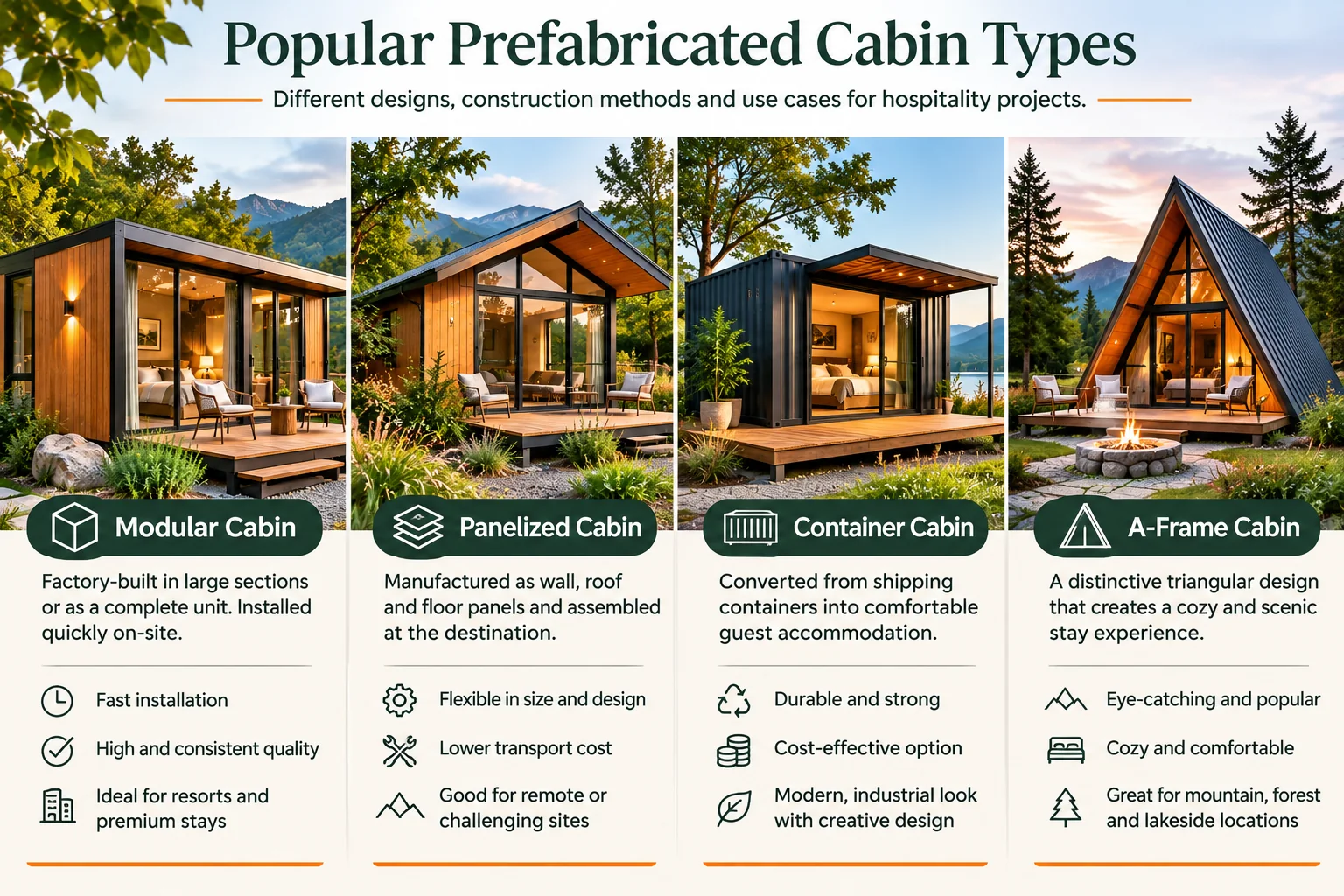
Modular cabins
These are constructed in substantial sections or complete units in a factory, then transported and installed on-site.
Some arrive with bathrooms, electrical systems, and interior finishes already installed.
They can offer good consistency, but transportation dimensions and installation access matter.
Panelized cabins
Walls, roofs, and other components are manufactured off-site and assembled at the destination.
This can be useful where transporting a fully assembled cabin would be difficult.
However, more work may be required on-site.
Flat-pack cabins
These are shipped as packages of components for assembly.
They may appear economical and can be easier to transport, but installation labour, finishing, and structural specifications require careful review.
Container-based accommodation
Shipping containers can be converted into guest rooms.
They can create an interesting architectural style, but cutting openings, insulation, ventilation, corrosion protection, and structural modifications need professional design.
A container isn’t automatically a cheap or comfortable hotel room.
A-frame cabins
A-frame describes the architectural shape, not necessarily the construction method.
An A-frame can be factory-built, panelized, or constructed conventionally.
It can look spectacular in photographs, but sloping walls can reduce usable interior space.
My recommendation
Don’t begin by asking which style looks most attractive.
Begin with the guest.
Will the room be used by couples, families, adventure travelers, or long-stay guests?
How much luggage will they bring?
Will they need a kitchenette?
Is the bathroom genuinely comfortable?
Can housekeeping clean it efficiently?
A beautiful cabin that functions poorly as a hotel room is a poor hospitality investment.
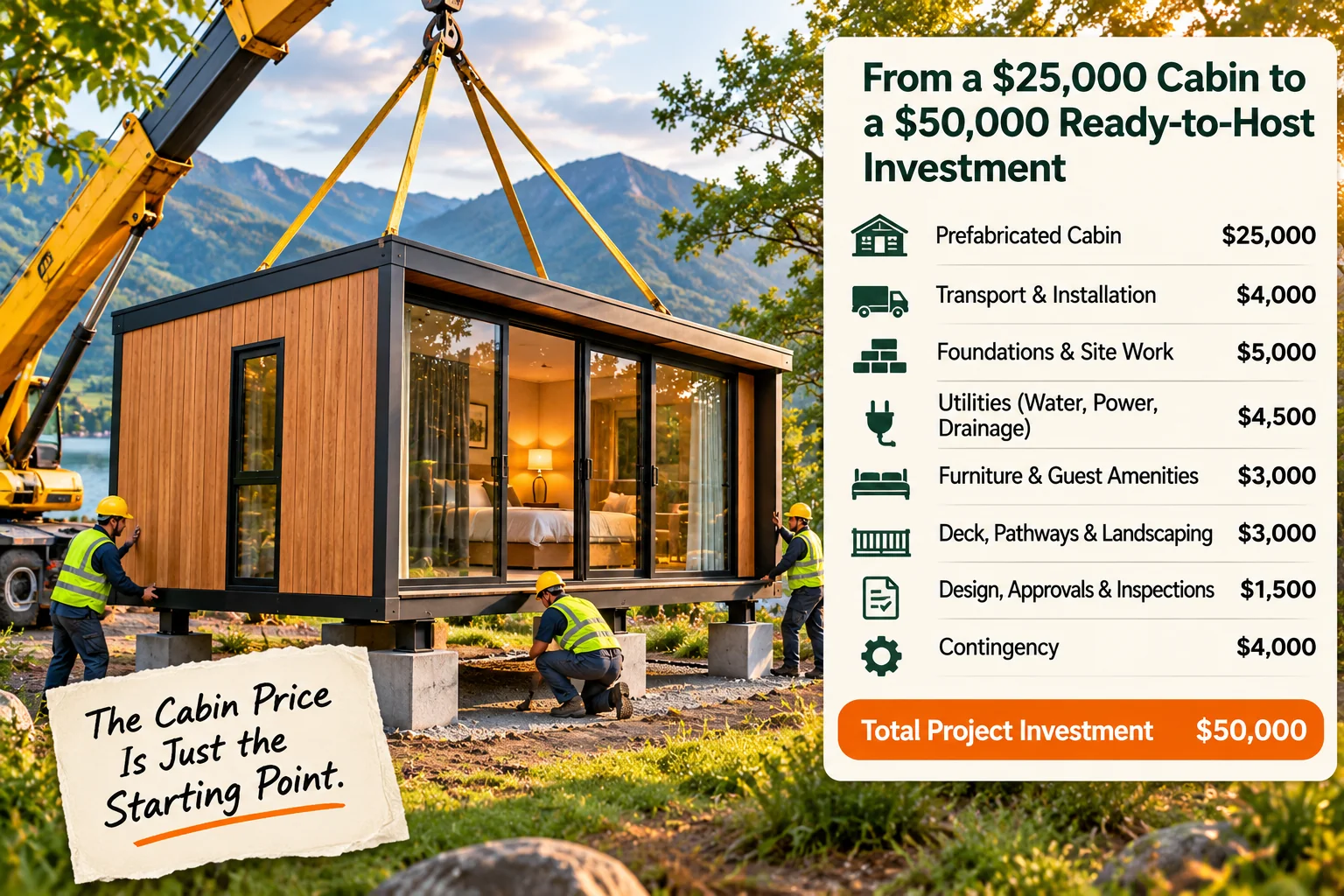
3. The $25,000 Cabin That Becomes a $50,000 Project
Let’s examine a hypothetical investment.
You find a supplier advertising a finished cabin for $25,000.
For this example, assume the land is already available and suitable for development.
Here’s what a project budget might look like.
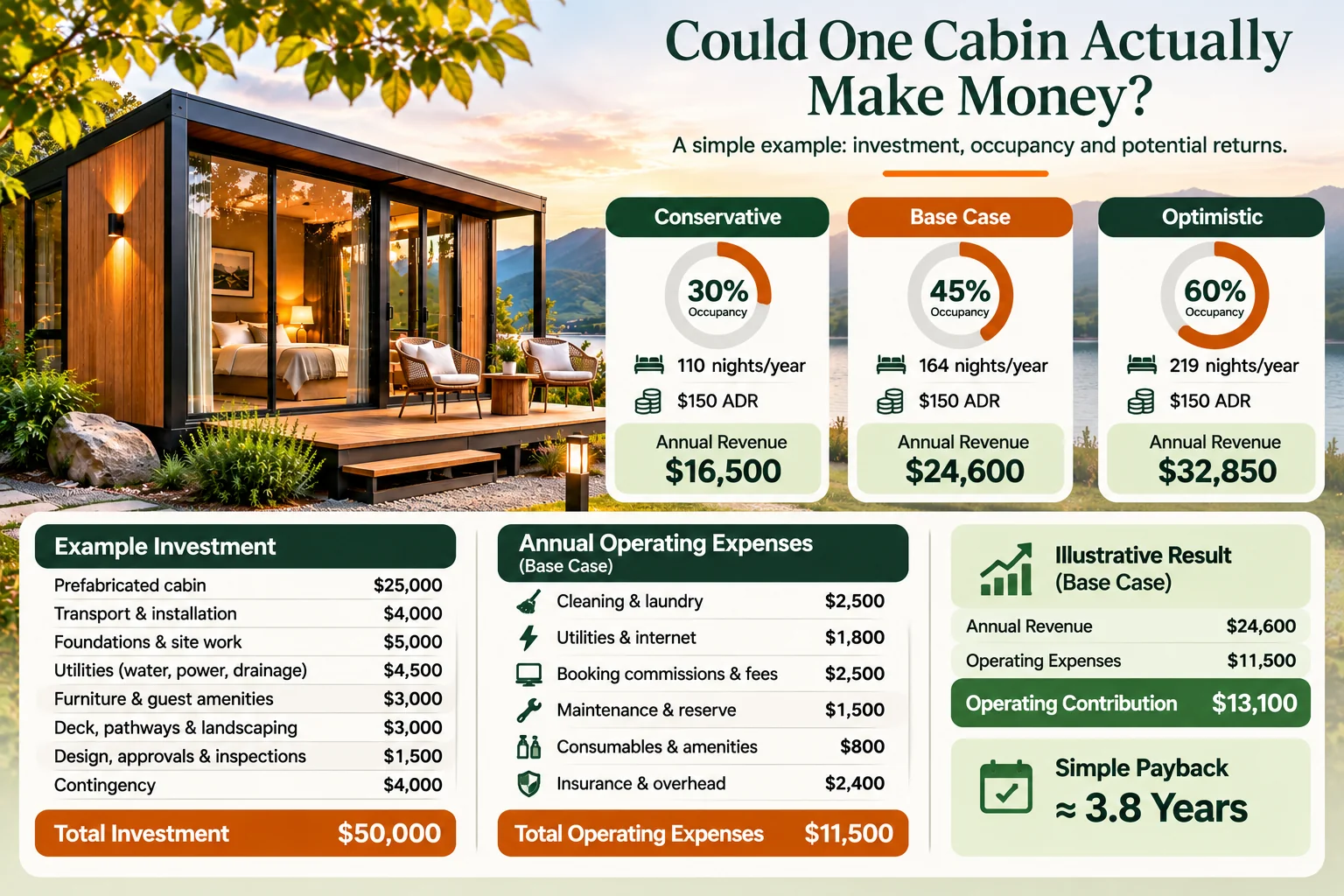
| Investment component | Illustrative cost |
|---|---|
| Prefabricated cabin | $25,000 |
| Transportation and installation | $4,000 |
| Foundations and site preparation | $5,000 |
| Water, power, drainage connections | $4,500 |
| Furniture, bedding and guest amenities | $3,000 |
| Deck, pathways and landscaping | $3,000 |
| Design, approvals and inspections | $1,500 |
| Contingency | $4,000 |
| Total investment | $50,000 |
These are hypothetical figures, not verified supplier quotations or a market-average estimate. Real costs vary substantially by country, location, cabin specifications, ground conditions, utilities, and regulations.
The project could cost less.
It could also cost considerably more.
A remote mountain site requiring a new road, retaining walls, off-grid power, water storage, or a septic system could have very different economics.
The costs buyers frequently overlook
Access: Can a truck reach the property? Can a crane operate safely?
Foundations: What does the soil investigation indicate?
Utilities: Are reliable water, power, wastewater, and internet connections available?
Climate: What insulation, heating, cooling, drainage, and moisture protection are needed?
Regulations: Is tourist accommodation permitted on the land?
Operations: Who cleans the cabin, receives guests, handles repairs, and responds to emergencies?
Distribution: How will guests discover and book the property?
A cabin manufacturer’s quotation may cover only one part of the investment.
The Qasim Verdict
Never compare the factory price of a cabin with the finished cost of a conventional hotel room.
Compare fully installed, legally operable, guest-ready accommodation on both sides.
That’s the only useful comparison.
4. Could One Cabin Actually Make Money?
Now let’s examine the revenue.
Suppose you’ve invested $50,000 in a guest-ready cabin.
You plan to charge $150 per night.
At first glance, that sounds attractive.
But the nightly rate isn’t your profit.
Let’s consider three occupancy scenarios.
| Scenario | Occupancy | Approx. sold nights/year | ADR | Annual room revenue |
|---|---|---|---|---|
| Conservative | 30% | 110 | $150 | $16,500 |
| Base case | 45% | 164 | $150 | $24,600 |
| Optimistic | 60% | 219 | $150 | $32,850 |
ADR means average daily rate, or average room revenue per occupied night.
For simplicity, these scenarios assume the same ADR throughout the year and availability for 365 nights. Real operations will have seasonality, discounts, maintenance closures, and different weekday and weekend rates.
What happens after operating expenses?
For the base case, assume:
| Annual expense | Illustrative amount |
|---|---|
| Cleaning and laundry | $2,500 |
| Utilities and internet | $1,800 |
| Booking commissions and payment fees | $2,500 |
| Maintenance and replacement reserve | $1,500 |
| Consumables and guest amenities | $800 |
| Insurance, administration and allocated overhead | $2,400 |
| Total operating expenses | $11,500 |
Annual room revenue: $24,600.
Illustrative operating cash contribution: $13,100.
That represents a 26.2% annual contribution relative to the initial $50,000 investment.
But don’t call that a guaranteed 26.2% investment return.
The example excludes financing costs, income taxes, depreciation, major capital replacements, and any land acquisition costs. Actual overhead and labour allocations may also be higher.
And it assumes the hotel can consistently achieve 45% occupancy at $150 ADR.
Simple payback
$50,000 ÷ $13,100 = approximately 3.8 years.
That is a simplified payback calculation before financing, taxes, and future major capital expenditure.
It’s useful as an initial screening measure, not a complete investment appraisal.
A proper investment decision should also examine cash flows over several years, the time value of money, financing, replacement costs, and the residual value of the asset.
Here’s the important part
If your location attracts guests only on weekends, 45% annual occupancy might be difficult.
If the property already has an established customer base, restaurant, activities, and booking team, it might be more achievable.
That’s why I would study the location before studying the cabin catalogue.
5. The Weekend Trap: Beautiful Cabins Don’t Automatically Fill Weekdays
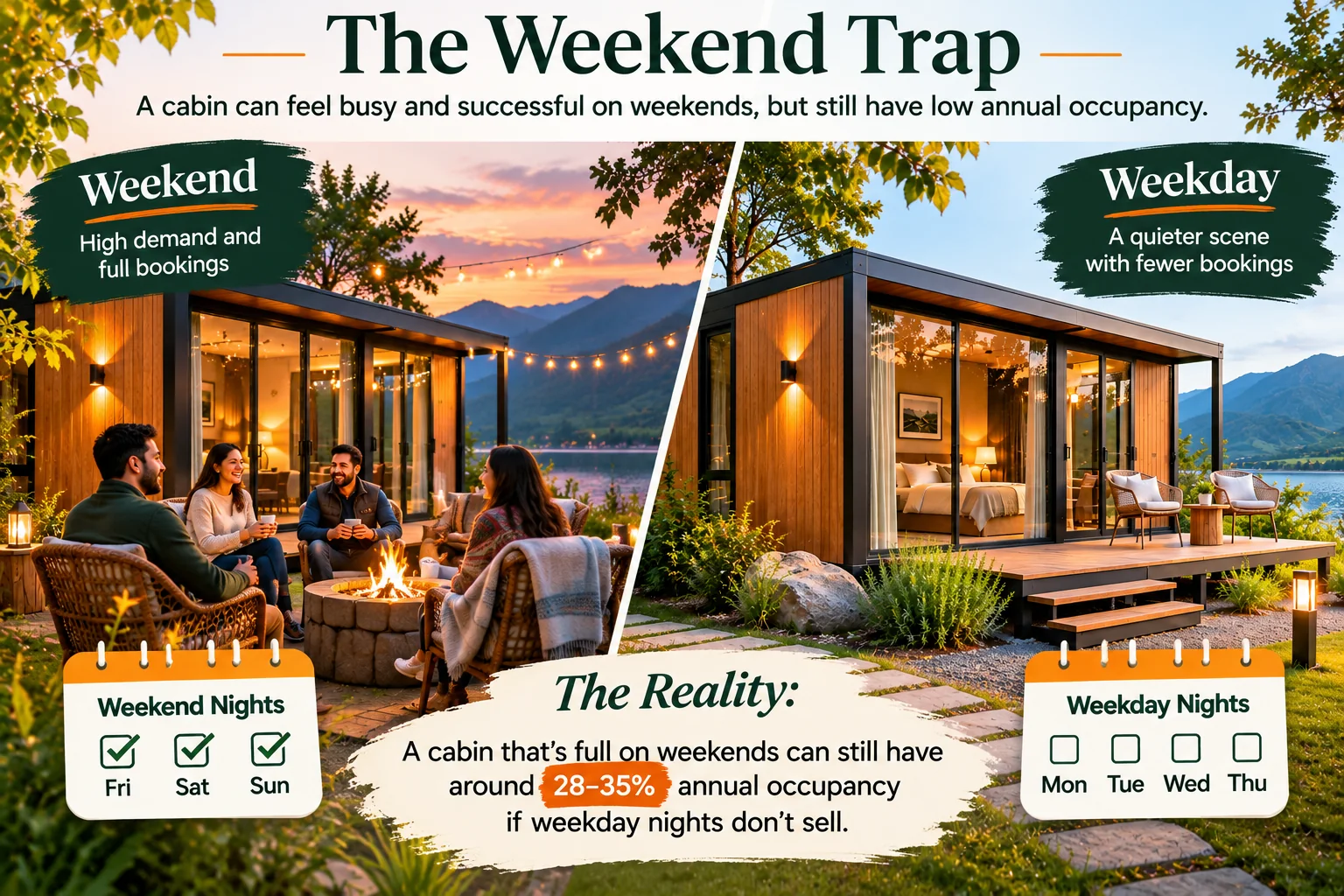
Imagine a cabin that books every Friday and Saturday.
That’s approximately eight or nine nights per month.
It may feel busy because weekends are consistently full.
But annual occupancy could still be around 28% if very few weekday nights sell.
This is one of the first questions I’d investigate for a leisure destination.
Who is going to stay on Monday, Tuesday, and Wednesday?
Potential demand might come from remote workers, couples on midweek breaks, international tourists, corporate retreats, wellness guests, or longer-stay travelers.
But those markets must actually exist in the destination.
A practical demand test
Before investing, I’d study at least 10 comparable accommodations within a realistic travel area.
I’d record:
- Weekday and weekend advertised rates
- Minimum-night requirements
- Seasonal rate changes
- Review volume and recency
- Guest complaints and recurring praise
- Amenities and view quality
- Distance from major population centers
- Nearby attractions and activities
I’d also review local tourism data, accommodation supply, and any reliable occupancy benchmarks.
Airbnb provides an earnings-estimation tool using comparable listings, but it explicitly notes that actual earnings depend on availability, pricing, and local demand.
An online estimate isn’t a business feasibility study.
My favorite question
Would people still book this cabin if we removed the beautiful sunset from the advertisement?
If the only attraction is a good photograph, the business may struggle.
A stronger concept gives guests multiple reasons to visit.
6. Sell the Experience, Not Just the Cabin
This is where I think resort operators have an advantage.
A cabin is accommodation.
A hospitality experience is something more.
Imagine two properties.
Property A: A modern cabin with a bed, bathroom, and outdoor deck.
Property B: A similar cabin with a private breakfast basket, guided nature walk, sunset dining experience, and optional stargazing session.
Which one has more opportunities to differentiate itself?
Property B may be able to create a stronger reason to book and generate additional revenue.
Of course, the experience must be delivered safely and profitably.
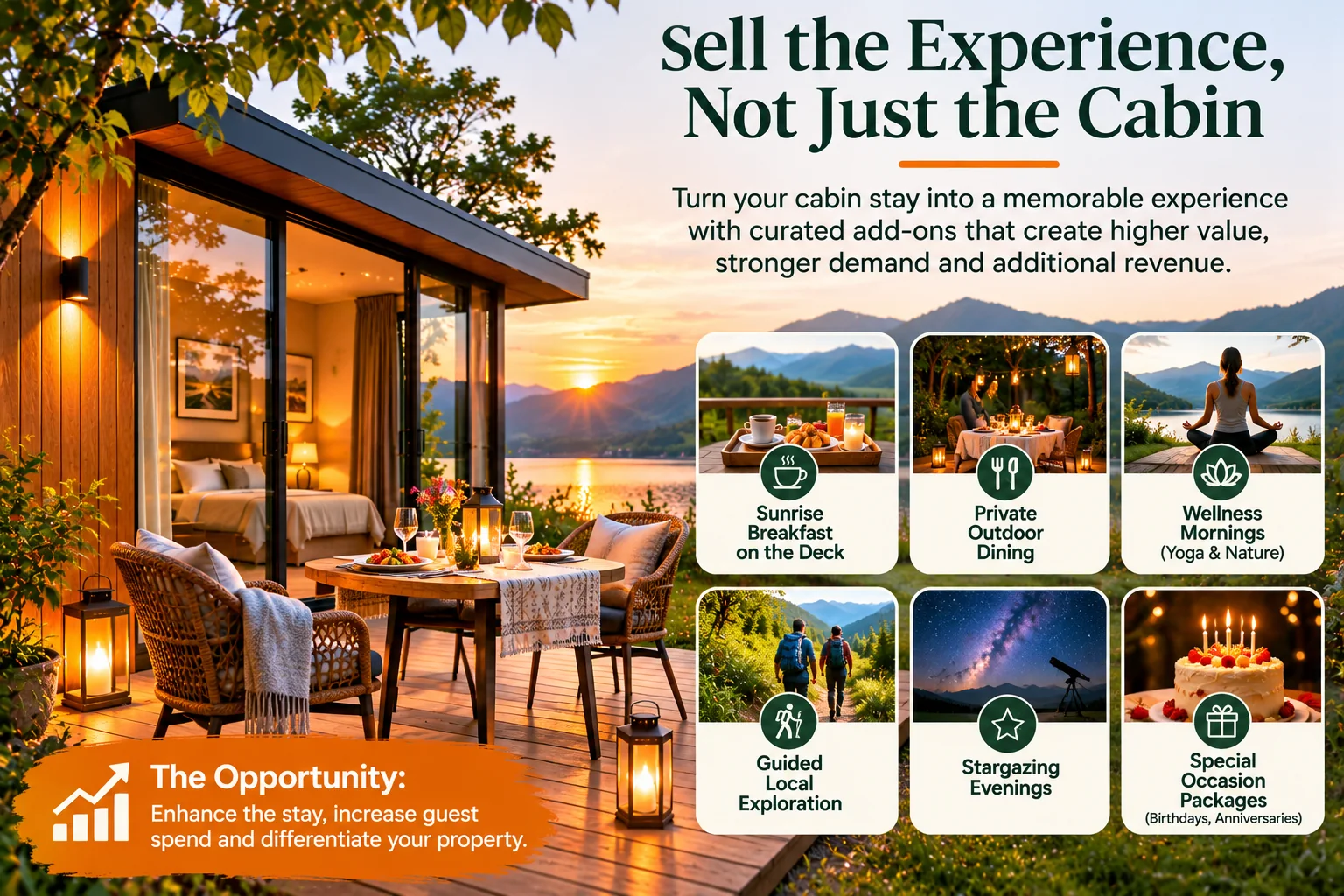
Six ideas worth investigating
1. Sunrise breakfast on the deck
A simple breakfast presentation can turn an ordinary morning into a memorable moment.
2. Private outdoor dining
Offer a pre-booked dinner experience using existing restaurant operations.
3. Wellness mornings
Yoga, guided stretching, or nature walks with appropriately qualified instructors.
4. Guided local exploration
Nature trails, cultural visits, or heritage experiences.
5. Stargazing evenings
Suitable for destinations with limited light pollution and safe outdoor viewing areas.
6. Special-occasion packages
Anniversaries, birthdays, and couple-oriented experiences with clear inclusions and pricing.
The revenue opportunity
Suppose the cabin generates $24,600 in annual room revenue.
If 25% of its 164 occupied nights result in an additional experience purchase worth $60, that’s approximately $2,460 in additional annual sales.
But those are sales, not profit.
Food, staffing, transport, equipment, commissions, and other delivery costs must be deducted.
And the extra revenue should never be assumed without testing guest demand.
The Qasim Verdict
I’d rather develop one well-positioned cabin with a genuinely compelling guest experience than install five generic cabins and hope beautiful photographs will fill them.
The accommodation attracts attention.
The complete experience creates differentiation.
7. Amazon, Alibaba, or a Specialist Cabin Manufacturer?
This is where sourcing becomes especially important.
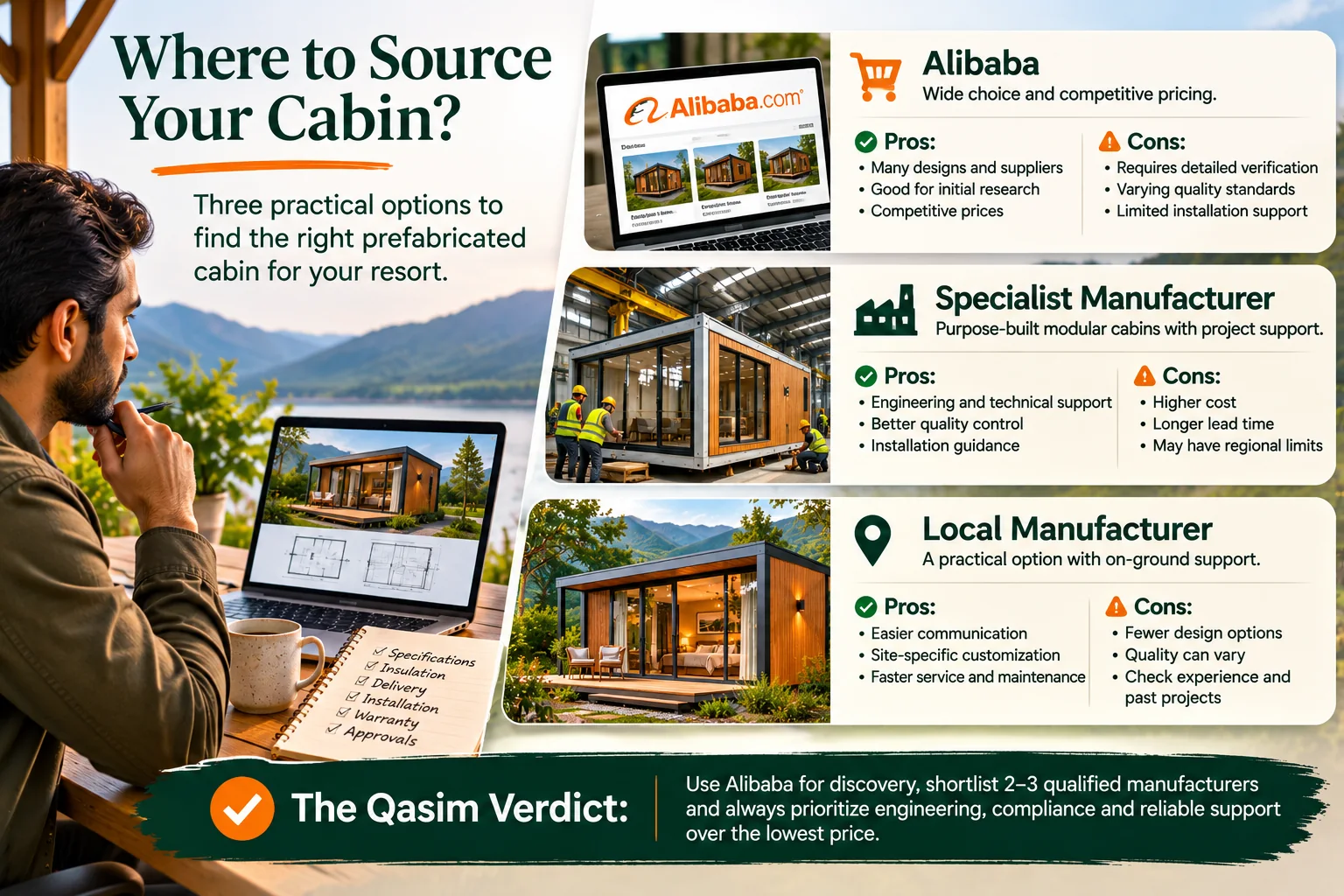
You may find cabins advertised on Alibaba, specialist modular-building websites, and regional manufacturers’ catalogues.
But this is not like buying restaurant lamps or serving trays.
You’re purchasing a building that must withstand weather, support occupants, connect to utilities, and comply with applicable regulations.
Alibaba: Useful for discovery, but verify everything
Alibaba can help identify manufacturers, compare designs, and request preliminary quotations.
However, I wouldn’t approve a cabin purchase based solely on a listing, promotional video, or low advertised price.
I’d request detailed drawings, structural specifications, material schedules, insulation values, electrical specifications, and written installation requirements.
I’d also want independent professional review before placing a significant order.
Specialist modular manufacturers
An established modular-building manufacturer may offer stronger project coordination, engineering documentation, and installation support.
But capabilities vary.
Some manufacture only the structure.
Others provide a more complete turnkey service.
Always clarify the scope.
Local manufacturers and contractors
A qualified local manufacturer can sometimes offer advantages in transportation, site inspections, climate adaptation, warranty response, and spare parts.
For a remote resort, those advantages may be significant.
Where I’d start looking
For industry background and manufacturer discovery:
- Modular Building Institute
- Alibaba.com
- International Code Council
- Regional modular-construction manufacturers and approved local building contractors
These are research starting points, not endorsements of individual cabin suppliers.
The Qasim Verdict
For a permanent hospitality investment, I’d prioritize engineering compliance, installation support, and supplier reliability over the lowest factory price.
A beautiful cabin that cannot obtain the required approvals is not a bargain.
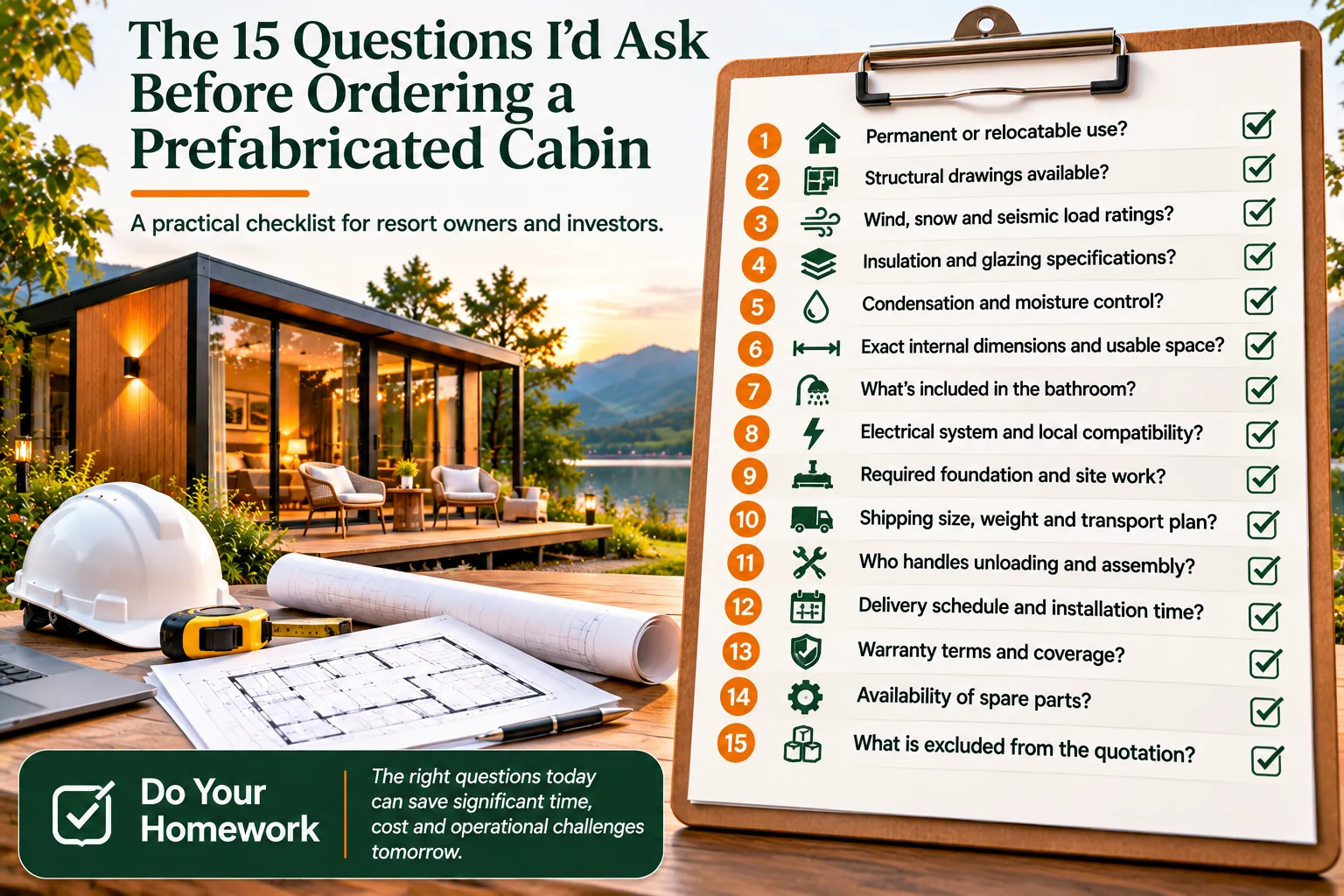
8. The 15 Questions I’d Ask Before Ordering a Prefabricated Cabin
This is the checklist I’d give a purchasing or development team.
| Question | Why it matters |
|---|---|
| 1. Is this intended for permanent or relocatable use? | Affects engineering and approvals |
| 2. Are structural drawings available? | Allows independent technical review |
| 3. What wind, snow and seismic loads is it designed for? | Must suit the actual location |
| 4. What insulation and glazing are included? | Affects comfort and energy use |
| 5. How is condensation controlled? | Helps prevent moisture problems |
| 6. What are the exact internal dimensions? | Determines usable guest space |
| 7. What is included in the bathroom? | Avoids unexpected fit-out costs |
| 8. Are electrical systems suitable for the destination? | Supports safe installation |
| 9. What foundation is required? | Influences site cost |
| 10. What is the shipping size and weight? | Determines transport feasibility |
| 11. Who handles unloading and assembly? | Prevents responsibility gaps |
| 12. What is the delivery schedule? | Affects opening plans |
| 13. What warranties apply? | Clarifies remedies and exclusions |
| 14. Are spare parts available? | Matters for long-term operation |
| 15. What is excluded from the quotation? | Reveals hidden project costs |
I’d also request references from completed projects in comparable climates and, where feasible, visit an installed unit.
And I’d have an independent engineer and relevant local professionals review the design.
The International Code Council’s off-site construction guidance emphasizes that modular buildings must satisfy applicable requirements in the jurisdiction where they’re installed.
A supplier’s claim that a cabin is “certified” doesn’t automatically mean it can legally operate as tourist accommodation in your location.
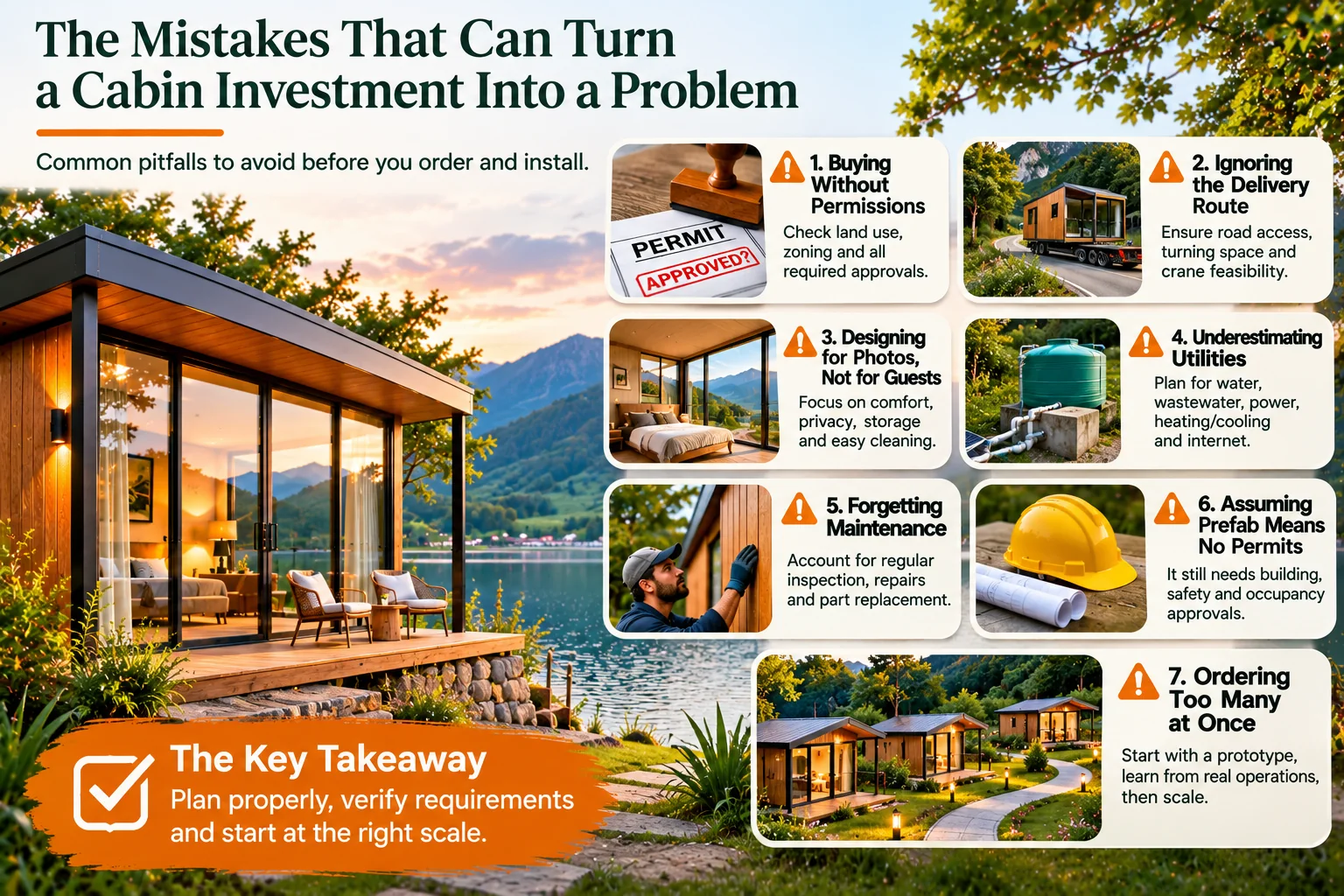
9. The Mistakes That Can Turn a Cabin Investment Into a Problem
Mistake 1: Buying before checking land-use permission
You may own the land and still lack permission to operate tourist accommodation.
Check zoning, environmental requirements, building approvals, wastewater rules, and any restrictions affecting the property.
Mistake 2: Ignoring the delivery route
A completed cabin may be too wide, tall, or heavy for the available road.
Narrow mountain roads, bridges, overhead cables, and steep turns can make transport difficult or expensive.
Mistake 3: Designing for photographs instead of guests
Floor-to-ceiling glass looks impressive.
But what happens when the afternoon sun overheats the room?
Is there privacy at night?
Can guests open windows safely?
Is there enough storage?
Can housekeeping clean the glass easily?
A successful design must work in real life.
Mistake 4: Underestimating utilities
Water supply, wastewater treatment, electrical capacity, heating, cooling, and internet connectivity can be major expenses.
Remote locations may need backup systems.
Mistake 5: Forgetting maintenance
Decks, roofs, seals, glazing, cladding, plumbing, and electrical equipment all require inspection and maintenance.
Ask the supplier for realistic maintenance instructions and replacement availability.
Mistake 6: Assuming prefab means no permits
Factory construction doesn’t remove the need for applicable planning, building, fire-safety, accessibility, or occupancy approvals.
Mistake 7: Ordering too many cabins immediately
I’d prefer a phased development where practical.
One prototype can reveal issues with comfort, housekeeping, guest preferences, and operating costs before the project expands.
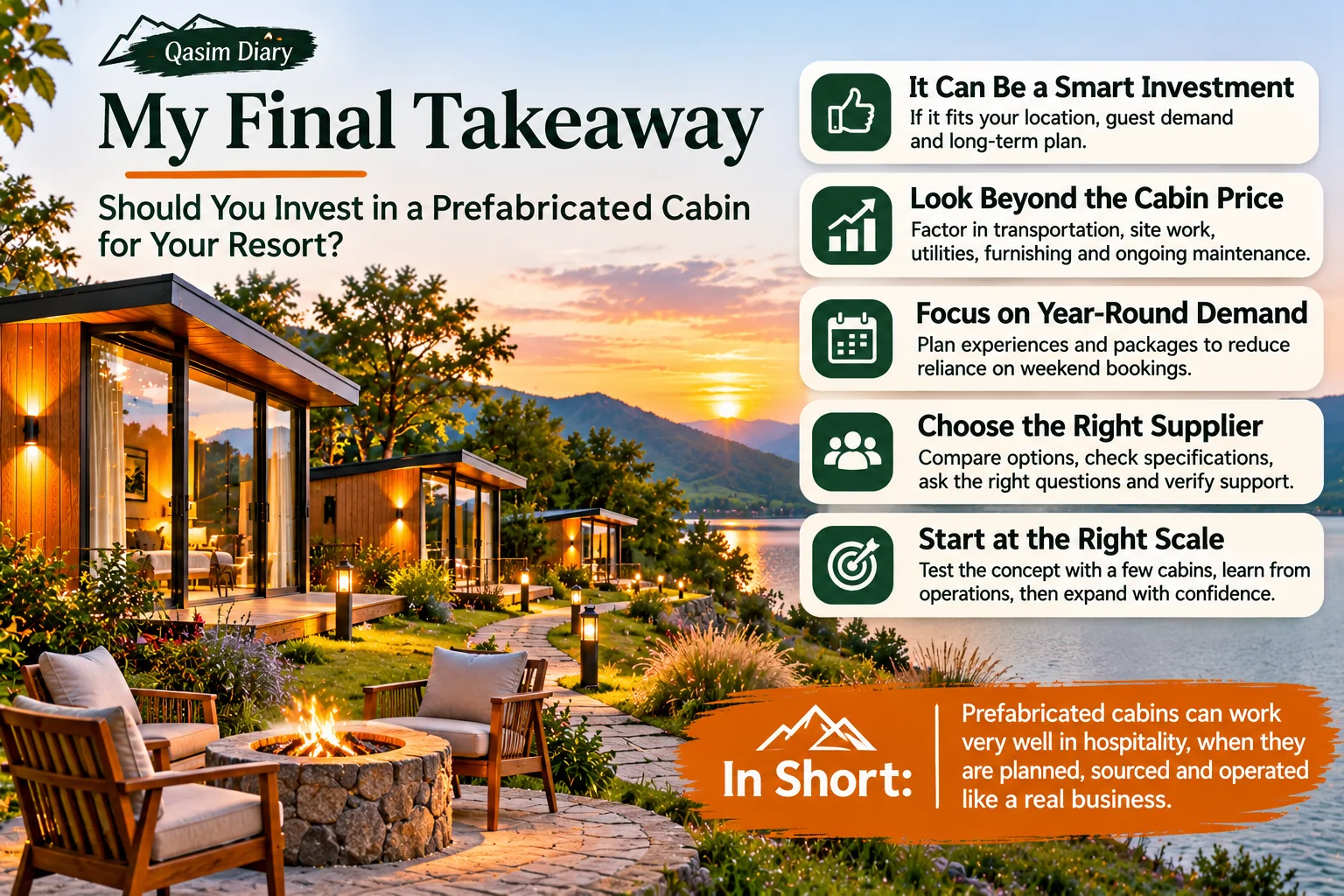
10. What About Sustainability?
Prefabricated cabins are frequently marketed as eco-friendly.
There may be genuine benefits.
Factory production can improve material planning and reduce certain forms of construction waste.
Building away from the final site can also reduce disruption during installation.
But sustainability depends on the entire project.
Consider the materials, transport distance, insulation, energy consumption, foundations, water management, wastewater treatment, and eventual replacement or disposal.
A cabin transported thousands of miles and operated with inefficient heating isn’t automatically environmentally superior to a well-designed locally constructed building.
For nature-based resorts, the surrounding landscape deserves as much attention as the structure.
Protect existing trees where feasible.
Manage drainage responsibly.
Avoid unnecessary light pollution.
Plan wastewater treatment carefully.
And make sure the development doesn’t damage the natural environment that attracts guests in the first place.
11. Would I Invest in One Cabin or Build Several?
My preference would depend on whether the property is already operating.
Scenario A: Existing resort
If the resort has an established restaurant, reception, housekeeping team, utilities, and guest demand, I’d investigate adding one or two premium cabins.
Existing infrastructure may reduce some incremental operating and development costs.
The cabins could also create opportunities for dining packages and other experiences.
Scenario B: Undeveloped land
I’d be more cautious.
A single cabin may still require roads, utilities, approvals, security, housekeeping arrangements, and marketing.
The infrastructure cost per cabin could be high.
I’d prepare a full site-development plan before deciding the number of units.
Scenario C: Remote nature retreat
I’d examine the access road, seasonal weather, emergency response, water availability, and maintenance requirements before focusing on cabin design.
An extraordinary view doesn’t compensate for an unsafe or impractical operating environment.
12. My 90-Day Plan Before Spending Money
Here’s how I’d investigate a cabin investment.
Days 1–15: Study demand
Identify the target guest.
Research competing accommodations, seasonal rates, booking patterns, and destination demand.
Establish a conservative ADR and occupancy forecast.
Days 16–30: Study the land
Check planning and building requirements.
Arrange appropriate site and technical assessments.
Investigate road access, drainage, power, water, and wastewater options.
Days 31–45: Compare suppliers
Request comparable quotations from at least three qualified suppliers.
Use identical requirements for size, materials, finishes, installation, and warranty.
Days 46–60: Build the financial model
Calculate total project investment, expected revenue, operating expenses, maintenance, financing, and contingency.
Stress-test lower occupancy and higher construction costs.
Days 61–75: Validate the concept
Speak with potential guests, travel operators, and existing hospitality businesses.
Review whether the proposed rate and experience are competitive.
Days 76–90: Make the decision
Proceed only when the location, approvals, supplier specifications, financial assumptions, and operational plan are credible.
If critical questions remain unanswered, delay the purchase.
A delayed investment is often less expensive than a rushed mistake.
Frequently Asked Questions
Are prefabricated cabins cheaper than traditional construction?
They can be, depending on the design, location, project size, and local construction market. But a fair comparison must include foundations, transport, installation, utilities, approvals, and finishing.
Can prefabricated cabins be used as hotel rooms?
Yes, where the building design and intended operation satisfy applicable local requirements. Hospitality use may involve additional safety, accessibility, fire, and licensing obligations.
How long does it take to install a prefab cabin?
It depends on the manufacturing method, supplier capacity, approvals, site readiness, delivery route, and installation scope. Physical assembly may be quick, while the complete development process can take much longer.
Can I import a cabin from Alibaba?
Potentially, but you must verify engineering, shipping, customs, applicable building standards, installation requirements, and supplier reliability. A factory listing alone is not sufficient.
What occupancy makes a cabin profitable?
There is no universal occupancy threshold. Profitability depends on the nightly rate, total investment, operating costs, financing, seasonality, and required return. Build a property-specific financial model.
Is one cabin enough to start a hospitality business?
It can be, but infrastructure and staffing costs may make a single standalone cabin less efficient than one added to an existing hospitality property.
The Qasim Verdict: Don’t Buy the Cabin. Build the Business Case.
I find prefabricated cabins interesting because they offer hospitality operators another way to develop accommodation.
They can be visually distinctive.
They may reduce some construction time.
They can help existing resorts expand their room inventory.
And when combined with a compelling location and thoughtful experiences, they can become attractive guest products.
But none of those advantages guarantees profitability.
A cabin isn’t a passive-income machine.
It’s a small hospitality operation that needs demand, service, maintenance, marketing, and financial discipline.
Before investing, I’d ask three questions:
Will people travel to this location?
Will they pay enough, often enough, to justify the complete investment?
Can we operate the cabin safely, consistently, and profitably?
If the answers are supported by evidence, a prefabricated cabin could be worth serious consideration.
If not, even the most beautiful cabin may become an expensive piece of scenery.
The opportunity isn’t in owning a cabin. It’s in creating a stay that guests are willing to pay for — again and again.
Sources & Further Reading
- Modular Building Institute — Permanent Modular Construction — Manufacturing process, hotel applications, construction timelines, and industry information.
- International Code Council — Off-Site Construction — Modular construction definitions, codes, inspections, and compliance.
- ICC/MBI Off-Site Construction Standards — Planning, fabrication, transportation, and regulatory requirements.
- Modular Building Institute — Inside the Modular Building Process — Transportation and manufacturing considerations.
- Modular Construction: A Comprehensive Review (2025) — Academic review of opportunities, costs, and challenges.
- Airbnb — How Earnings Estimates Work — Methodology and limitations of estimated short-term rental earnings.
- Airbnb — Calculating Your Payout — Booking fees and payout calculations.
Editorial disclosure: This is an independent research-based article. The example prices, financial projections, occupancy scenarios, and payback calculations are hypothetical, not supplier quotations or investment forecasts. No manufacturer or cabin product has been personally tested for this article. Readers should obtain professional engineering, legal, financial, and regulatory advice before committing to a development.